

stack of books drawing tumblr
You are here: Blog / Archives for not-knowing
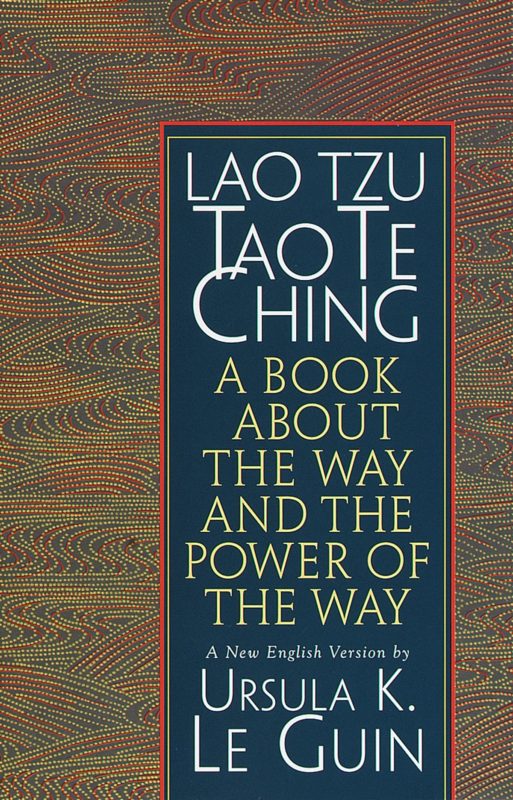
In the introduction to her translation of Lao Tzu's Tao Te Ching, Ursula K. Le Guin writes:
The first Tao Te Ching I ever saw was the Paul Carus edition of 1898, bound in yellow clothe stamped with blue and red Chinese designs and characters. It was a venerable object of mystery, which I soon investigated, and found more fascinating inside than out. The book was my father's; he read in it often. Once I saw him making notes from it and asked what he was doing. He said he was marking which chapters he'd like to have read at his funeral.
A few years ago, when you could actually shop in a bookstore and talk to strangers, an elderly woman walked up to me in a Half Price Books and said she had nothing to read.
"Well, you're in the right place," I said.
We got to talking and discovered we both enjoyed poetry. She said a lot of people in her life were dying so she was reading Lao Tzu.
"Lao Tzu?" I said. "I love Lao Tzu."
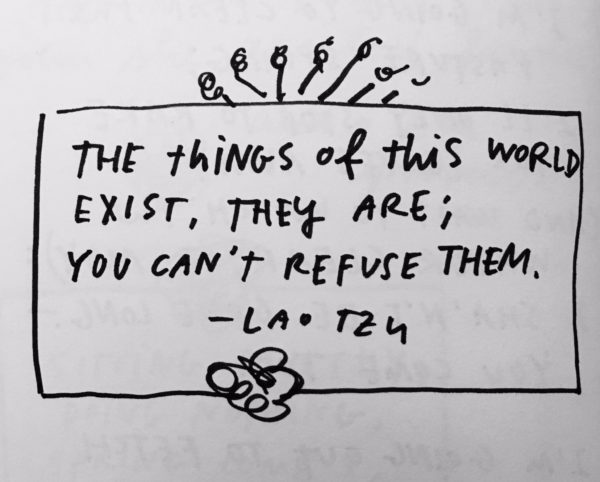
We walked together from section to section. I browsed; she talked. At one point she recited some Robert Frost and some Basho:
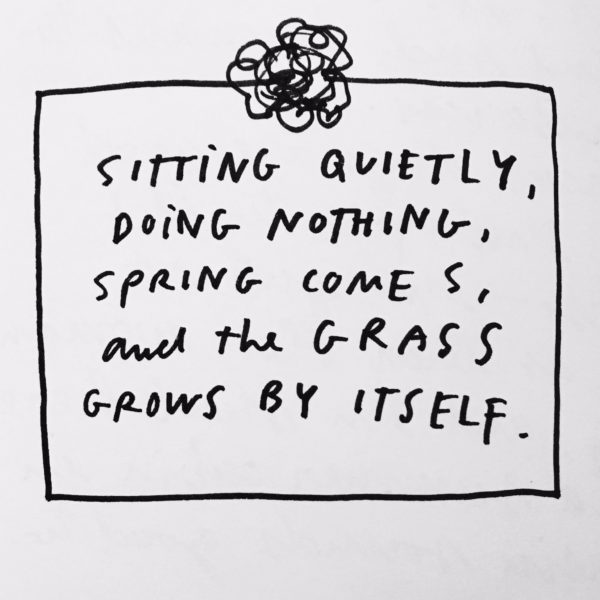
Eventually we said our goodbyes. I think of this woman now when I pick up the Tao Te Ching, and I wonder how she's doing.
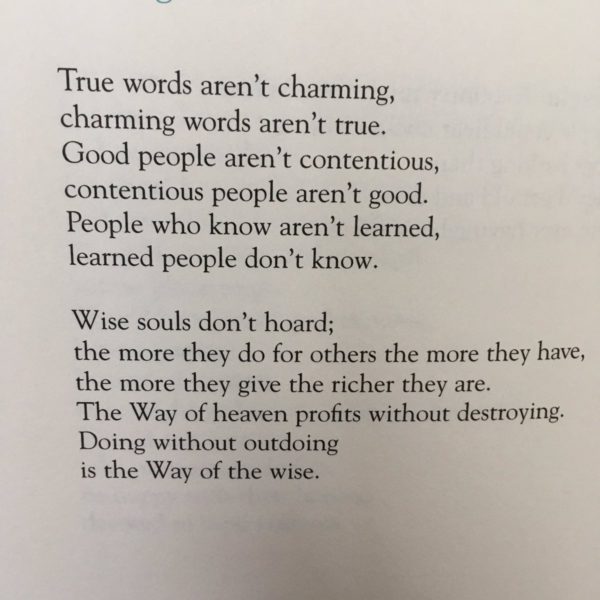
"It is the most lovable of all the great religious texts," Le Guin writes. "Funny, keen, kind, modest, indestructibly outrageous, and inexhaustibly refreshing. Of all the deep springs, this is the purest water. To me, it is also the deepest spring."
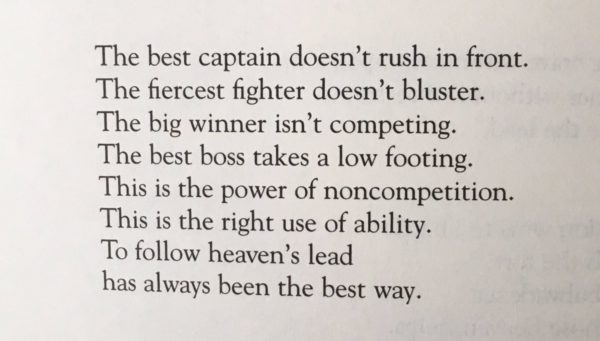
Every poem seems to me a subtweet of our crooked world and our lousy, corrupt leaders.
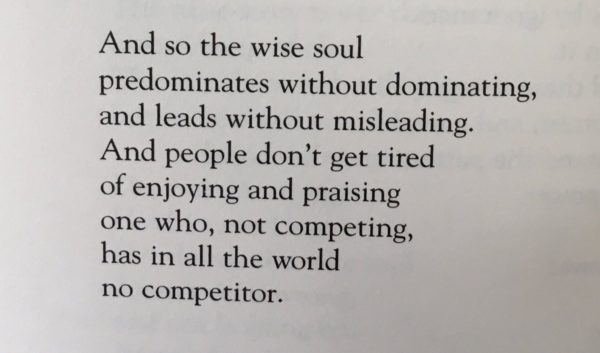
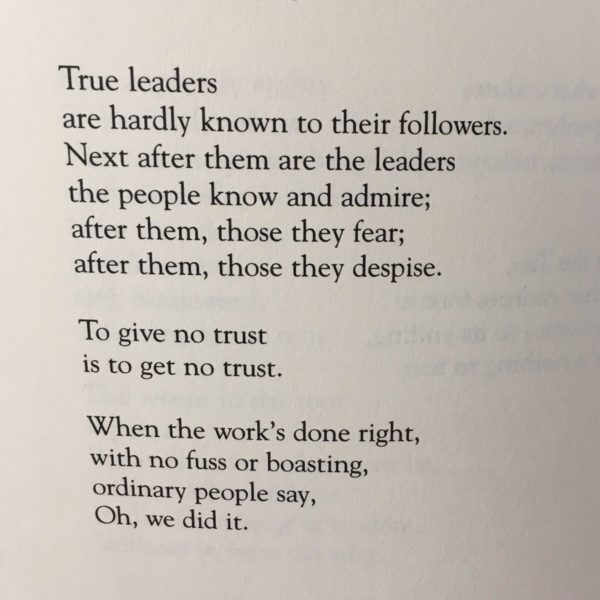
And Le Guin's footnotes are perfect:
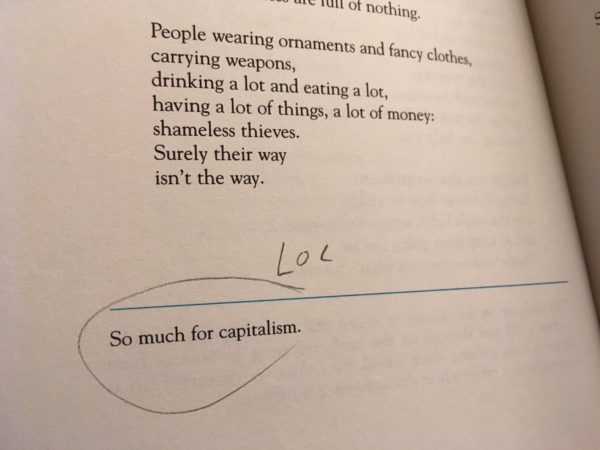
If you read Le Guin after reading this translation, you realize how many lines from her books could've been lifted from Lao Tzu.
This sentence from The Left Hand of Darkness, for example:
"To learn which questions are unanswerable, and not to answer them: this skill is most needful in times of stress and darkness."
Or this one:
"The only thing that makes life possible is permanent, intolerable uncertainty: not knowing what comes next."
Le Guin's version of theTao Te Ching (more excerpts over at Brain Pickings) was a great solace to me for the past four years, so much so that I put it in the recommended reading for Keep Going. And there's a fairly new reprinting, which means it's pretty easy to find.
* * *
Every Saturday Friday* I put one of my favorite books on the Bookshelf. To see more of my favorite books, check out my reading years.
* In the interest of preserving my sanity, I'm cutting my daily blogging, and hopefully all my online time, down to Monday-Friday.
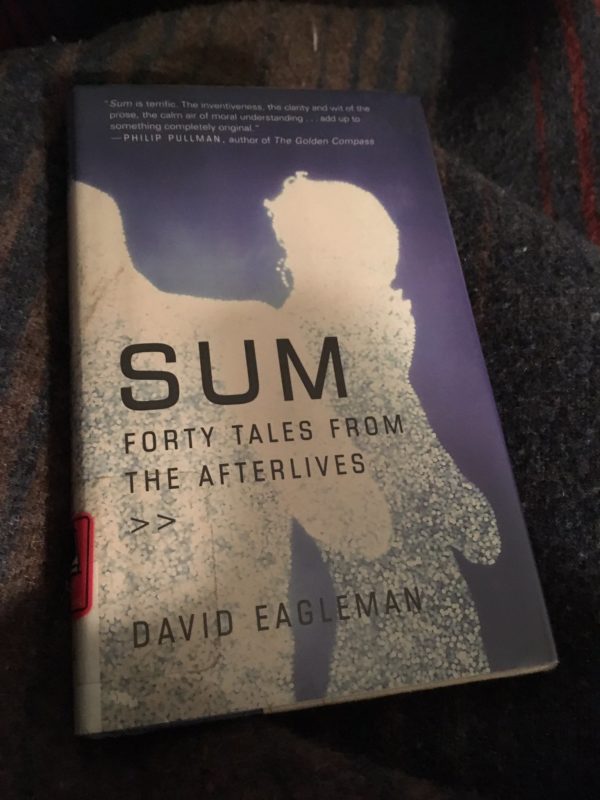
David Eagleman's Sum: Forty Tales from the Afterlives was published in February 2009. I read it in January 2017. (I called it "good pre-dream reading.") Now I'm writing about it in February 2021. These dates suggest to me that it is a great wintering book, a collection of possibilities(that word will have more relevance later) in a season in which the possibilities feel quite grim: Death, frozen pipes, snow that is white and terrifying like a blank sheet of paper.
There are two afterlives in this book that I think about often.
The first is from the title story, "Sum," in which you "relive all your experiences, but this time, with the events re-shuffled into a new order," and "all the moments which share a quality are grouped together." So you sleep for 30 years, sit on the toilet for 5 years, have sex for 7 months, experience pain for 27 hours, etc. That story is a reminder that "a life where episodes are split into tiny swallowable pieces" is a well-designed and endurable one.
The second is the afterlife in "Metamorphosis," a limbo-esque lobby the dead wait in until every single person on Earth has ceased to remember them. It starts this way: "There are three deaths: the first is when the body ceases to function. The second is when the body is consigned to the grave. The third is that moment, sometime in the future, when your name is spoken for the last time."
I think of these three deaths whenever a loved one dies. Their first and second death has passed, but their third and final death has not, and the absolute earliest it will is at the moment my brain forgets their name. So, until my own first death, I keep them alive. This is easiest for my favorite musicians: Put on their record, and their voice fills the room.
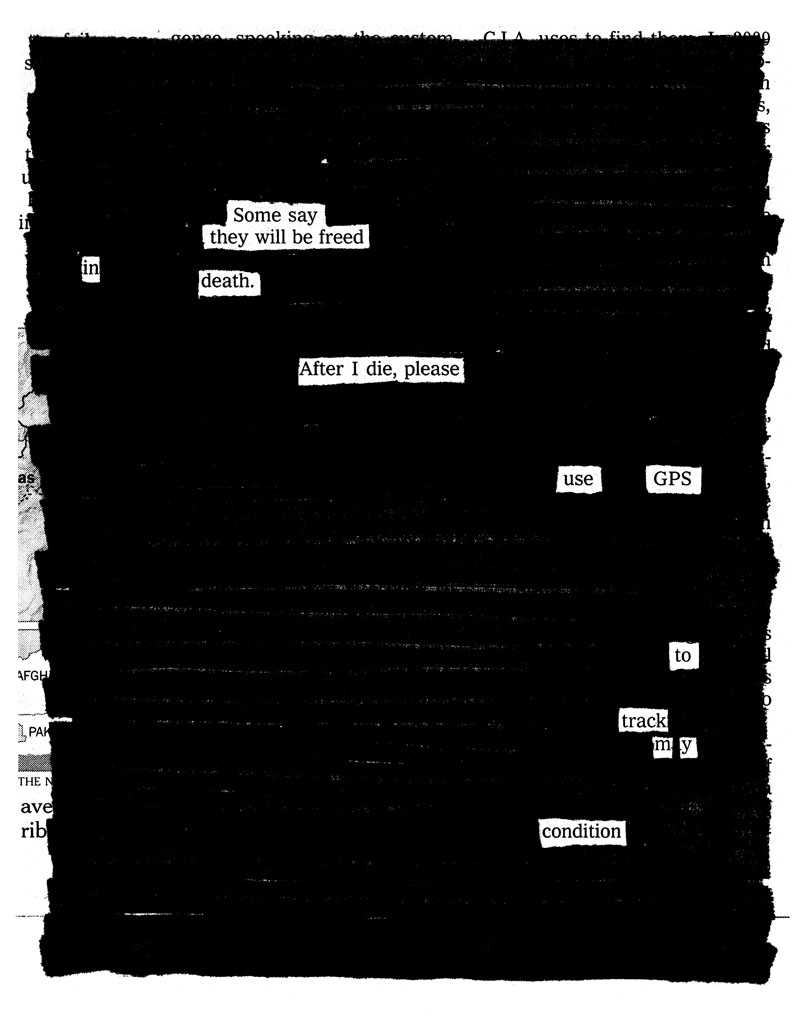
One question that it didn't even occur to me to ask when I first read the book: What are Eagleman's actual religious beliefs? From the 2011 New Yorker profile of Eagleman called "The Possibilian":
Eagleman was brought up as a secular Jew and became an atheist in his teens. Lately, though, he'd taken to calling himself a Possibilian—a denomination of his own invention. Science had taught him to be skeptical of cosmic certainties, he told me. From the unfathomed complexity of brain tissue—"essentially an alien computational material"—to the mystery of dark matter, we know too little about our own minds and the universe around us to insist on strict atheism, he said. "And we know far too much to commit to a particular religious story." Why not revel in the alternatives? […] "Part of the scientific temperament is this tolerance for holding multiple hypotheses in mind at the same time," he said. "As Voltaire said, uncertainty is an uncomfortable position. But certainty is an absurd one."
"I'm not saying here is the answer," he says. "I'm just celebrating the vastness of our ignorance." (For more, look to his piece, "Why I am a Possibilian.")
It's really of no matter. Sum is like the movieGroundhog Day: it gets at something universal that will be claimed by humans of all walks.
* * *
[PS. The New Yorker profile, which I only read this afternoon, features Eagleman hanging out with one of my heroes, Brian Eno, and hooking drummers up to an EEG monitor while they played. "The question is: do drummers have different brains from the rest of us?" Eno says. "Everyone who has ever worked in a band is sure that they do." (Eno, an early reader and enthusiast of Sum, wrote some soundscapes to go along with readings, and the composer Max Richter actually turned it into an opera.)]
* * *
Every Saturday I put one of my favorite books on the Bookshelf. To see more of my favorite books, check out my reading years.
My friend Alan Jacobs, writing about "the seductions of prediction," ends with William Goldman's great line, "Nobody knows anything."
The line could describe almost everything in life, but here it is in its filmmaking context:
…the single most important fact, perhaps, of the entire movie industry:
NOBODY KNOWS ANYTHING.
If there is a Roman numeral I to this book, that's it…
Again, for emphasis—
NOBODY KNOWS ANYTHING.
Not one person in the entire motion picture field knows for a certainty what's going to work. Every time out it's a guess—and, if you're lucky, an educated one.
That's from the "Studio Executives" chapter of Goldman's book, Adventures in the Screen Trade: A Personal View of Hollywood and Screenwriting.(Designer Michael Beirut called the book "one of my favorite non-design books that is really about design," and writes that Goldman was "one of the best writers ever on the day-in, day-out struggles faced by anyone attempting to create good work in a hostile environment.")
* * *
On our walk this morning, my wife was telling me about the difference between risk and uncertainty that Arthur Brooks brings up in his piece about how to stay calm in the pandemic.
"Uncertainty involves unknown possible outcomes and thus unknowable probabilities," he writes. "Risk involves known possible outcomes and probabilities that we can estimate."
Our problem, Brooks says, is that we try to convert uncertainty into risk by bombarding ourselves with information. But, as everybody with half a functioning brainstem knows, looking to social media for help right now is a futile exercise in "wallowing in uncertainty." (I love that phrase.)
What does Brooks suggest? The same thing that works when there's not a pandemic going on:
Start by acknowledging that you do not know what is going to happen in this crisis. Next, distinguish between what can and can't be known right now, and thus recognize that gorging on all the available information will not really resolve your knowledge deficit—you won't be able to turn uncertainty into risk by spending more hours watching CNN, because the certainty you seek is not attainable. Finally, resolve that while you don't know what will happen next week or next month, you do know that you are alive and well right now, and refuse to waste the gift of this day. (One more practical suggestion: Limit your consumption of news to half an hour in the morning, and stay off social media except to talk to friends. No cheating!)
I would go farther than Brooks and suggest not starting your morning with the news at all. (I have been reading poetry while lazing about on the couch.)
I'm also sticking with Laurie Anderson's advice, which begins chapter one of Keep Going:
The world may end. You're right. But that's not a reason to be scared. None of us know what will happen. Don't spend time worrying about it. Make the most beautiful thing you can. Try to do that every day. That's it. You know? What are you working for, posterity? We don't know if there is any posterity.
(Emphasis mine.)
Mary Ruefle, in a wonderful conversation with David Naimon:
I would rather wonder than know. It makes it more and more difficult to be alive on earth in these times, when your inclination is to wonder rather than to know.
I suppose the example that comes to mind is: it used to be if you were having dinner with people and someone said, "Who's the fastest animal on earth?" An amazing conversation would ensue. And now someone pops their phone out and looks up the answer. And it breaks my heart….
I really, really don't like it when people look things up on their iPhones…. I mean, sometimes, of course, I'm no idiot. The encyclopedic nature of the information that's available is fantastic, but I would still rather wonder than know.
I think wondering is a way of inhabiting and lingering. There seems to be more dwelling. To dwell, inhabit, and linger. I'm interested in those things. And you can do that when you don't know.
We tend to, as human beings, our impulse is, once we know, once we have the answer, we move on. So we're constantly moving from one thing to the other. I would rather inhabit the question, or dwell. For me, that is the place I want to live in.
I have an encyclopedia at home. It never occurred to me there was ever anything wrong with it until my friend pointed out it was an Encyclopedia Brittanica from 1910 and it might be a little outdated. I still look things up in it! […]
My oldest son used to ask me questions and when I said I didn't know the answer, he'd say, "Look it up on the Goggle!" It takes discipline, now, not to look things up immediately, but to sit and wonder…
Then again, when you do look things up, you find more things to wonder about.
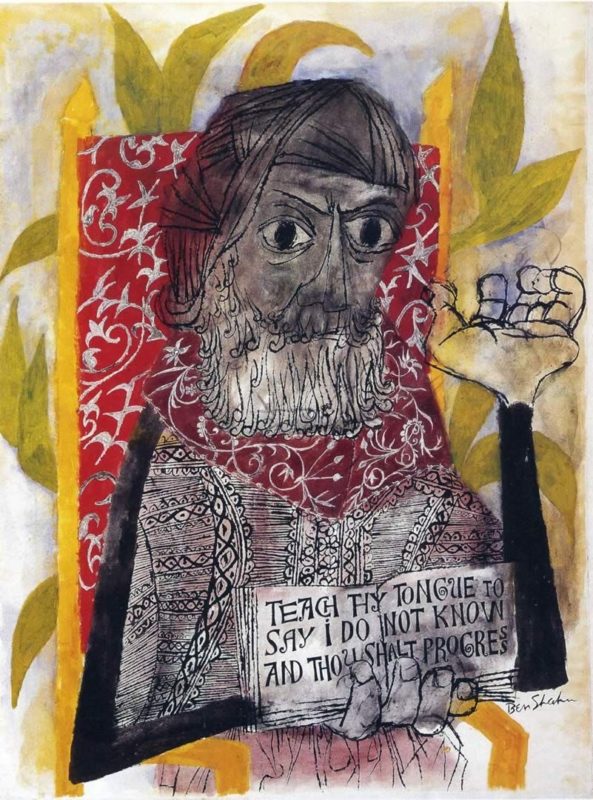
Here is Ben Shahn's Maimonides, painted in 1954. "Teach thy tongue to say I do not know and thou shalt progress."
I've long believed that "not-knowing" is the proper mental state for making art, but I'm starting to think it's the proper mental state for going about life in general. (As Mike Monteiro says, "The secret to being good at anything is to approach it like a curious idiot, rather than a know-it-all genius.")
"Whatever inspiration is, it's born from a continuous 'I don't know,'" said the poet Wislawa Szymborska in her 1996 Nobel Prize lecture. She spoke of why she values "that little phrase 'I don't know' so highly":
It's small, but it flies on mighty wings. It expands our lives to include the spaces within us as well as those outer expanses in which our tiny Earth hangs suspended. If Isaac Newton had never said to himself "I don't know," the apples in his little orchard might have dropped to the ground like hailstones and at best he would have stooped to pick them up and gobble them with gusto. Had my compatriot Marie Sklodowska-Curie never said to herself "I don't know", she probably would have wound up teaching chemistry at some private high school for young ladies from good families, and would have ended her days performing this otherwise perfectly respectable job. But she kept on saying "I don't know," and these words led her, not just once but twice, to Stockholm, where restless, questing spirits are occasionally rewarded with the Nobel Prize….
Szymborska said that inspiration was not just the domain of poets and artists, but people in all sorts of work — work that " becomes one continuous adventure as long as they manage to keep discovering new challenges in it." Their curiosity is never quelled, and "[a] swarm of new questions emerges from every problem they solve."
Here is how the actor Philip Seymour Hoffman described getting into the role of Truman Capote:
I think you have to kind of start with saying, "I don't know. I don't know how the hell I'm going to do this at all." Really be as naive as possible, you know, as ignorant as possible, because then you can keep yourself as wide open as possible for anything that could be of help, could be of use…
"Naiveté," is the title of the penultimate chapter of Gareth Matthews' Philosophy and the Young Child, and in which he writes, "An adolescent or adult who writes poetry or does philosophy has to cultivate innocence to be able to puzzle and muse over the simplest ways of saying and seeing things."
There's a big connection between philosophy, wonder, and puzzlement. Wittgenstein: "A philosophical problem has the form: 'I don't know my way about.'"
I think this "puzzlement" is in good art, too. The artist, like the philosopher, is exploring what she doesn't know.
Bertrand Russell said of philosophy,
"if it cannotanswer so many questions as we could wish, has at least the power ofasking questions which increase the interest of the world, and show the strangeness and wonder lying just below the surface even in the commonest things of daily life."
Sounds like art to me!
This is, again, why I rail against being called an "expert" or a "guru": the minute you think you know everything — or anything, really — you're out of that state that leads to good creative work. The more time you spend giving people answers, the less time you spend asking questions.
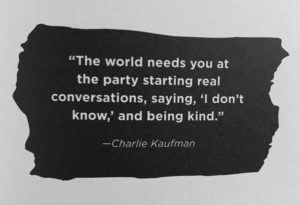 Here's Matthews on why we should make room in our lives for philosophy, or what Robert Spaemann calls "institutionalized naiveté":
Sophistication may bring increased knowledge and, perhaps, a refined sensibility. But it may also encourage a cult of experts, dull sensitivity, and may reward flatulence in thought and language. Every society needs a barefoot Socrates to ask childishly simple (and childishly difficult!) questions, to force its members to reexamine what they have been thoughtlessly taking for granted.
"[A] cult of experts, dull sensitivity, and… flatulence in thought and language." Sounds like a conference of "thought leaders"!
More about the importance of not-knowing and uncertainty in chapter seven of my latest, Keep Going.
(Thanks to @seekandspeak for sending me Szymborska's Nobel lecture.)
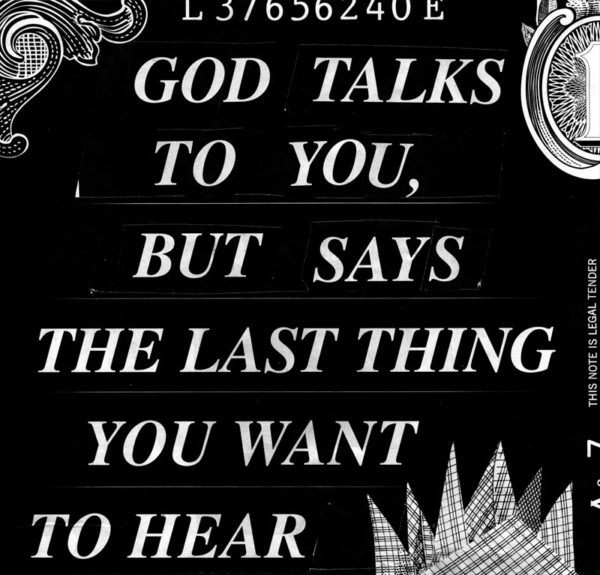
"Write what you know," goes the adage, but you don't really know what you know until you write about it.
May Sarton: "I have written every poem, every novel, for the same purpose—to find out what I think, to know where I stand."
Kathryn Schulz: "For me, the engine of writing is almost always ignorance. I write to figure out what I think."
Adam Philips: "Anybody who writes knows you don't simply write what you believe. You write to find out what you believe, or what you can afford to believe."
James Baldwin (it's his birthday today) went even further: "When you're writing, you're trying to find out something which you don't know. The whole language of writing for me is finding out what you don't want to know, what you don't want to find out.")
The more I think about it the more it knocks me out.
It's one thing to write to find out what you don't know, but to write to find out what you don't want to know takes guts.
"You're finding out what you got," George Saunders says, "and it might not be what you want to have."
My friend Dave, a few months ago, he asked me, "So what are you excited about right now?" And I couldn't give him a good answer. "I don't know," I said. "I just don't know."
I relayed the question to my friend Curt, and he shrugged it off, and said, "That just means you're looking."
A few weeks later, I found it. I found the thing to get excited about. The thing to work on.
I was so incredibly excited about the thing I was working on, because it felt completely, 100% my own, coming to me fast, as if it already existed. As if it had always existed. I had an energy, a borderline mania, working on it. All of my parts were in alignment. It felt like I had something that I needed years ago that I think other people need, too. I worked for a solid month, and I came up with the thing, and I delivered the first version of it, and it worked . It was right. It did exactly what I wanted it to do.
And then… I let myself be talked out of working on my vision of the thing into working on something else that seemed only slightly different, but wrong. It was as if, overnight, all my energy, all of my excitement, had been sucked out of me. And I struggled for a week, trying to see the thing that I was supposed to work on. And I couldn't see it.
This morning I walked past the bomb site and something in me snapped. What the hell am I doing? I asked my wife. She said, "You've let yourself be talked out of working on what you know you're supposed to be working on."
Now I'm back. And I can see it. And I can see a way of working on it, of making it exist, and putting it out into the world.
And nobody's going to talk me out of it.
This post was a tantrum. (We all have them sometimes. Forgive me.)

"We are here on Earth to fart around. Don't let anybody tell you any different."—Kurt Vonnegut
One thing I've learned in my brief tenure as an artist: it's the side projects that blow up.
By side projects I mean the stuff that you thought was just farting around. That's actually the good stuff. That's when the magic happens.
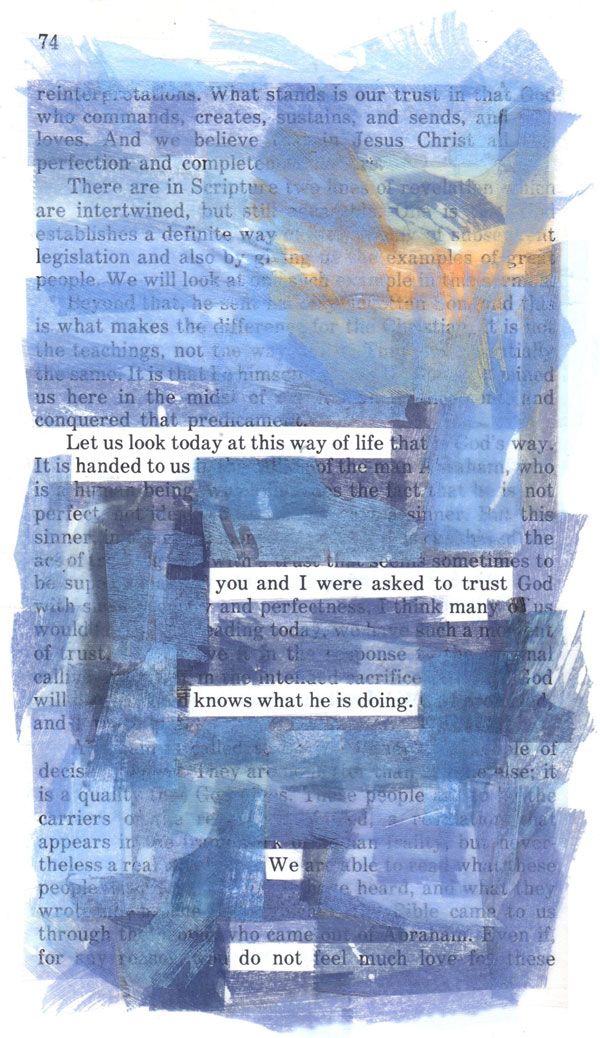
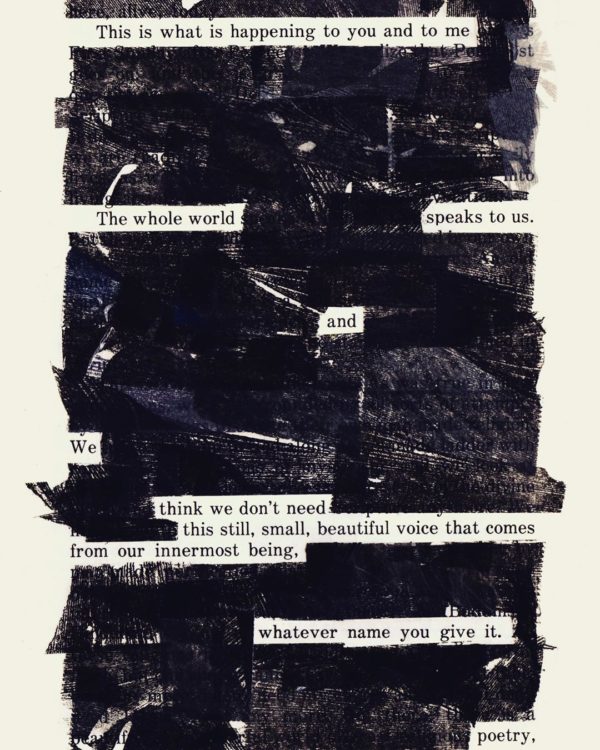
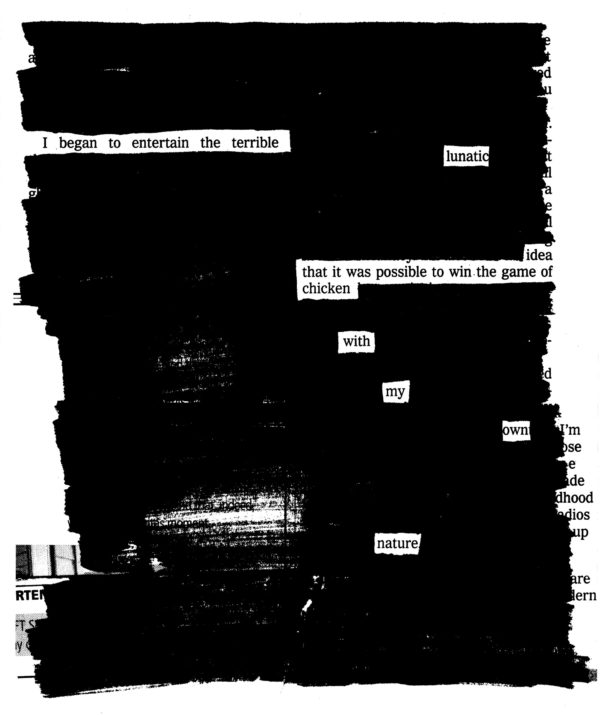
Four years ago I had no idea what I was doing. I thought I was a short story writer. I was trying to write stories. Then one day I took a Sharpie to a stack of newspapers. All the sudden I was a poet. Pretty soon a diversion—a side project—turned into my main thing (whether I wanted it to or not).
Had I been focused only on my goal of writing fiction, had I not allowed myself the room to experiment and take on a side project, I'd never be where I am now.
So the lesson is: take time for side projects. Take time to fart around.

Trying hard to solve that impossible problem? Hit the topless bar, take a warm shower, and sleep on it.
Three tips I gathered from Jonah Lehrer's great article in the July 28th New Yorker called "The Eureka Hunt," all about "insight," where our good ideas come from, when they come to us, and why.
The formula:
total immersion ? relaxing distraction = moment of insight
The insight process…is a delicate mental balancing act. At first, the brain lavishes the scarce resource of attention on a single problem. But, once the brain is sufficiently focussed, the cortex needs to relax in order to seek out the more remote association in the right hemisphere, which will provide the insight. "The relaxation phase is crucial," Jung-Beeman said. "That's why so many insights happen during warm showers." Another ideal moment for insights, according to the scientists, is the early morning, right after we wake up. The drowsy brain is unwound and disorganized, open to all sorts of unconventional ideas. The right hemisphere is also unusually active. Jung-Beeman said, "The problem with the morning, though, is that we're always so rushed. We've got to get the kids ready for school, so we leap out of bed and never give ourselves a chance to think." He recommends that if we're stuck on a difficult problem, it's better to set the alarm clock a few minutes early so that we have time to lie in bed and ruminate. We do some of our best thinking while we're still half asleep.
The mathematician Henri Poincaré had his "seminal insight into non-Euclidean geometry…while he was boarding a bus."
Poincaré insisted that the best way to think about complex problems is to immerse yourself in the problem until you hit an impasse. Then, when it seems that "nothing good has been accomplished," you should find a way to distract yourself, preferably by going on a "walk or a journey". The answer will arrive when you least expect it.
And let's not forget Richard Feynman:
the Nobel Prize winning physicist, preferred the relaxed atmosphere of a topless bar, where he would sip 7UP, "watch the entertainment," and, if inspiration struck, scribble equations on cocktail napkins.
The good stuff comes along when you're not forcing it—what Lynda Barry and Donald Barthelme call "not-knowing."
My "Eureka!" moments always come to me in the shower, which is why I keep a dry-erase marker in the bathroom.
When do y'all get your best ideas?
This site participates in the Amazon Affiliates program, the proceeds of which keep it free for anyone to read.
stack of books drawing tumblr
Source: https://austinkleon.com/tag/not-knowing/
Posted by: pantonemenim69.blogspot.com
0 Response to "stack of books drawing tumblr"
Post a Comment