

What Is Racial Makeup Of Trump Supporters
Pew Research Center conducted this study to understand how Americans' views across a range of different domains have changed since 2016 and how those changes have impacted the coalitions of the ii major candidates for president. For this analysis, we conducted an online survey of xi,001 U.S. adults (including 9,114 registered voters) between July 27 and Aug. ii, 2020.
Everyone who took part is a member of the Center's American Trends Console (ATP), an online survey panel that is recruited through national, random sampling of residential addresses. This style nearly all U.S. adults have a chance of selection. The survey is weighted to be representative of the U.S. adult population by gender, race, ethnicity, partisan affiliation, didactics and other categories. Read more almost the ATP'due south methodology. Hither are the questions used for this report, along with responses, and its methodology.
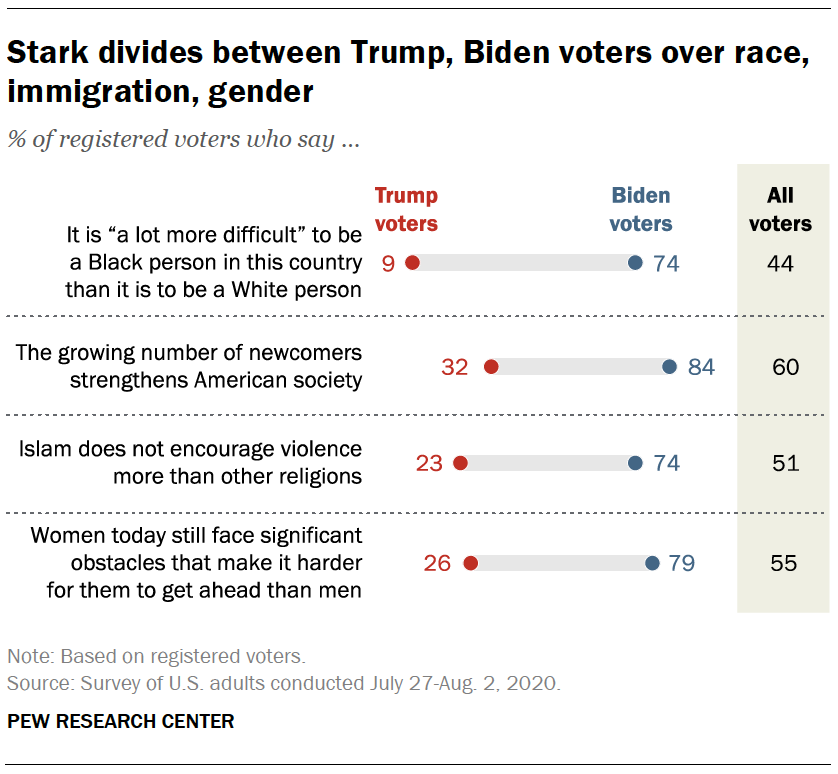 During the 2016 presidential campaign, supporters of Donald Trump and Hillary Clinton disagreed over nearly everything, including the extent to which Blackness adults in this country are disadvantaged considering of their race and women because of their gender.
Today, these differences are even wider among voters who support Trump and those who back Joe Biden.
Across a range of political values – around race, gender and family, immigration and organized religion – at that place are stark contrasts betwixt voters who back up Trump and those planning to vote for Biden in November.
On some, such as attitudes well-nigh immigrants' affect on American lodge, the differences between Trump and Biden supporters, while large, are no larger than the gap between Trump and Clinton voters iv years agone.
But in opinions about race and gender, in particular, the divides are much wider. Among all registered voters, 44% say it is a lot more than difficult to exist a Black person than a White person in this land; 32% say it is a fiddling more difficult, while 23% say information technology is no more difficult. The share of voters who say it is a lot more difficult to be Black has increased ix percentage points since 2016.
This modify has come up entirely among supporters of the Democratic candidates: 74% of Biden supporters say information technology is a lot more difficult to be Black than White, while a smaller majority of Clinton supporters (57%) said this in 2016. Among Trump supporters, there has been virtually no alter since 2016. Currently, ix% say information technology is a lot more difficult to be Black than White; 11% said this four years ago.
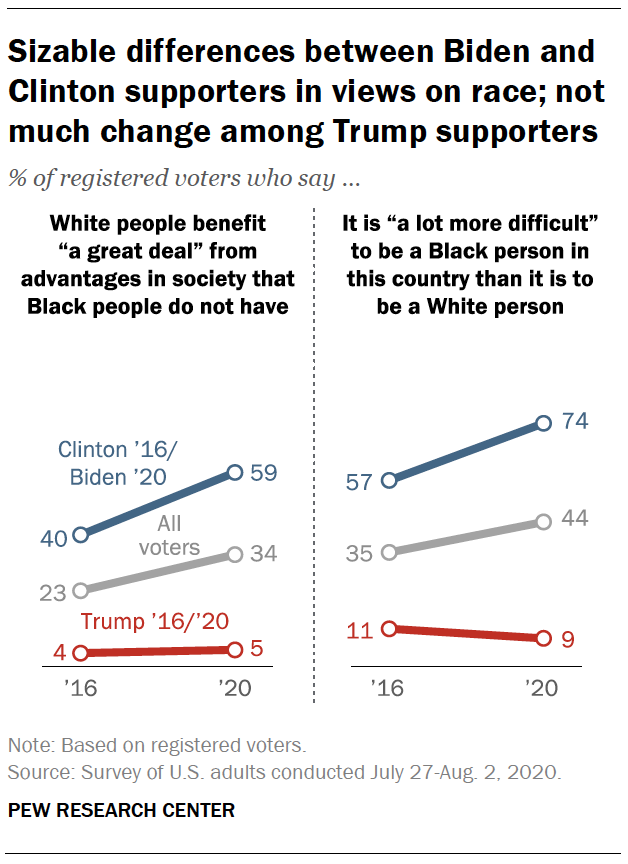 Thus the gap in opinions between Trump and Biden supporters in views of whether it is a lot more hard to be Black (65 pct points) is considerably larger than the divergence betwixt Trump and Clinton supporters in 2016 (46 points).
Biden supporters today also are more likely than Clinton supporters four years ago to say that White people benefit a neat deal from advantages in society that Black people do not have. Currently, 34% of all registered voters say White people benefit a bully bargain from advantages that Black people lack, up from 23% in July 2016.
Once again, the increase has come just amongst supporters of Democratic candidates: 59% of Biden supporters say White people benefit a bully deal from societal advantages that Black people do not have. Fewer than one-half (xl%) of Clinton supporters said this four years ago. Just 5% of Trump supporters say White people accept a corking deal of unfair advantages, which is nearly unchanged from 2016 (4%).
The survey by Pew Research Heart, conducted July 27-Aug. 2 amidst 11,001 U.S. adults (including nine,114 registered voters) on the Center'south American Trends Panel, also finds growing divergence between the ii camps on attitudes near gender and family: Biden voters today are at present somewhat more likely than Clinton voters were to say women continue to face obstacles that make it harder for them to get ahead than men, while Trump supporters are now somewhat less likely to say this than they were in 2016.
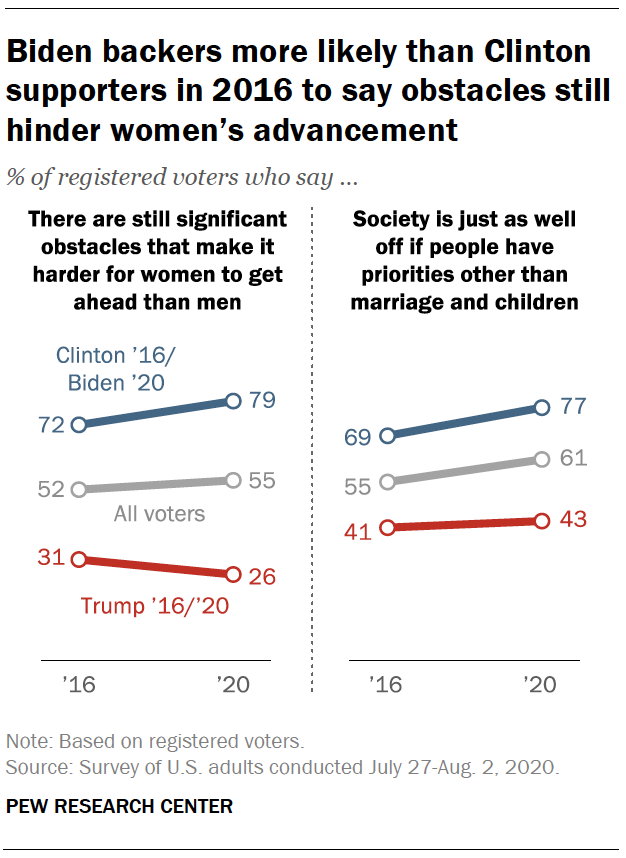 Opinion amid all voters has changed fiddling on whether women keep to face obstacles that go far harder for them to get ahead than men. Currently, 55% say there are still significant obstacles that make it more than hard for women than men to get ahead; 44% say the obstacles that one time made it harder for women to become ahead are now largely gone.
Amid Biden supporters, 79% say women still face up significant obstacles that make it harder for them to accelerate; a smaller majority of Clinton supporters (72%) expressed this view in 2016. By dissimilarity, a somewhat smaller share of Trump supporters limited this view today (26%) than did and then four years agone (31%).
While stark divides betwixt Trump and Biden supporters are evident on two other themes that were central to the 2016 campaign – views of immigrants and Islam – these divides are roughly comparable to the divides seen betwixt Trump and Clinton voters in 2016.
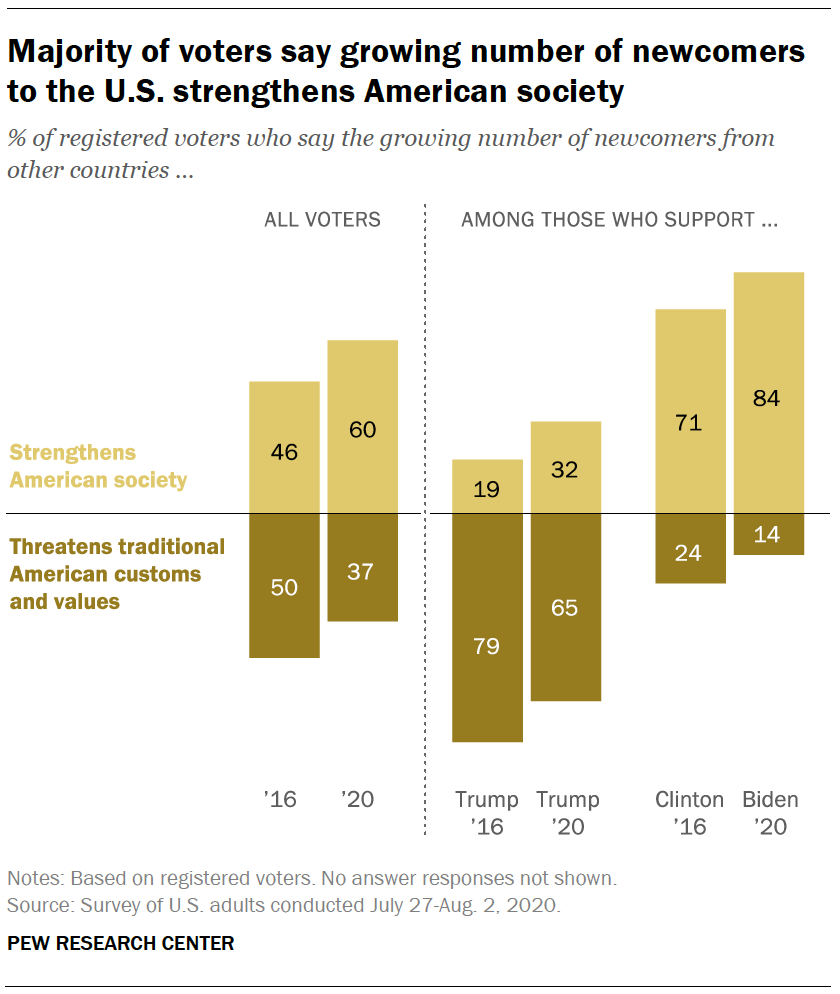
An increasing share of registered voters – Trump and Biden supporters alike – say the growing number of newcomers to the country strengthens American lodge. In the new survey, 60% say this, while 37% say this threatens the nation'south customs and values. In 2016, opinion was divided: 50% said increasing numbers of newcomers to the U.S. were more of a threat to American customs and values, while 46% said they strengthened society.
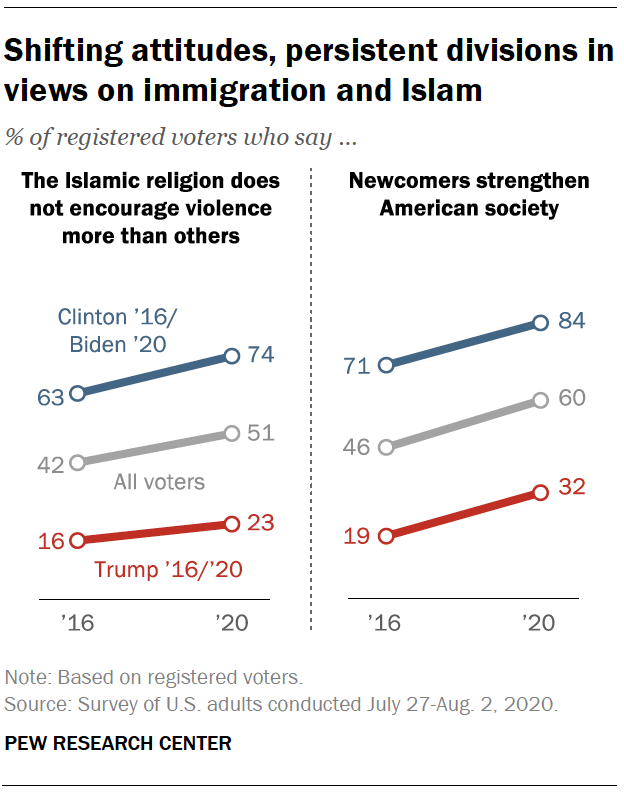 Just about a 3rd of Trump supporters (32%) say immigrants exercise more to strengthen society, but this is a xiii pct indicate increase from 19% in 2016. Biden supporters are more likely than Clinton supporters 4 years ago to say the growing number of newcomers strengthens gild (84% vs. 71%).
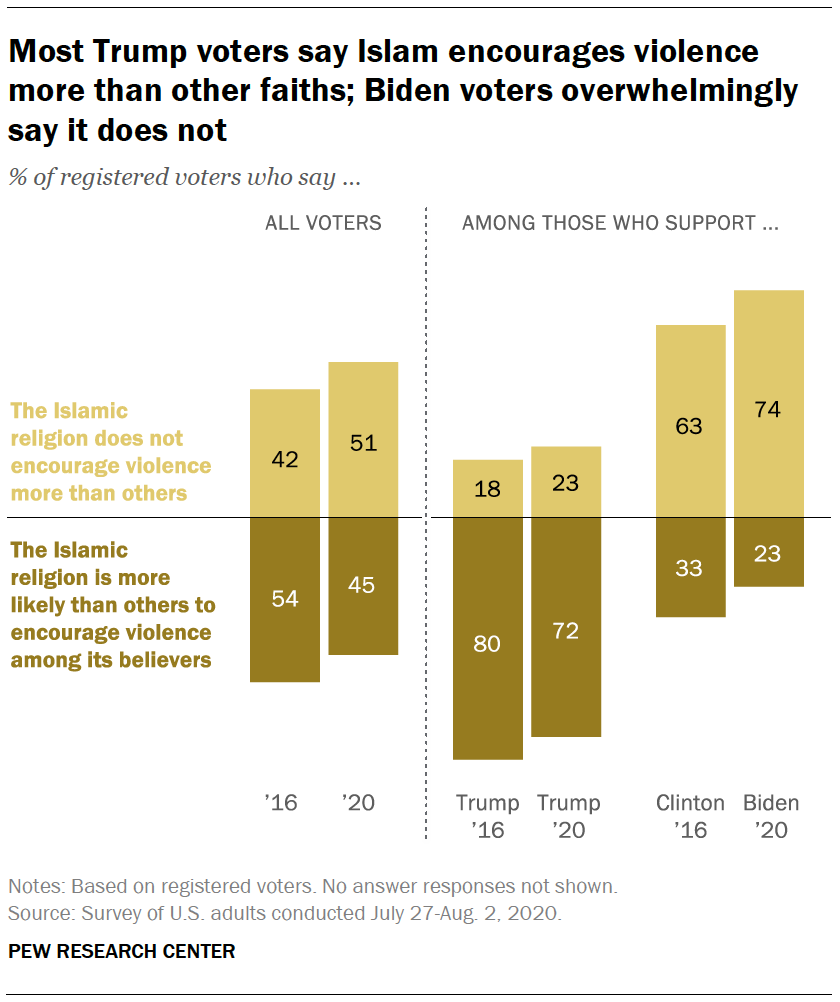
There also has been a shift beyond both the Republican and Autonomous coalitions in views of whether Islam is more associated with violence than other religions. Today, 51% of voters say the Islamic religion does non encourage violence amidst its believers more than other religions, while 45% say it does. Four years ago, a 54% majority said Islam was more than likely than other religions to encourage violence among its followers.
Well-nigh Trump supporters (72%) continue to associate Islam with violence, though the share saying this has declined 8 points since 2016. An even larger bulk of Biden supporters (74%) than Clinton supporters (63%) say Islam does not encourage violence more than other religions.
Biden, Trump coalitions diverge over perceptions of structural racism
Overall, 44% of Americans now say that information technology is a lot more hard to exist a Black person in the U.S. than it is to be a White person, while 32% say it is a footling more difficult and 23% say it is no more difficult. The share saying it is a lot more difficult to be Black than White is now 9 percentage points higher than it was in the summer of 2016.
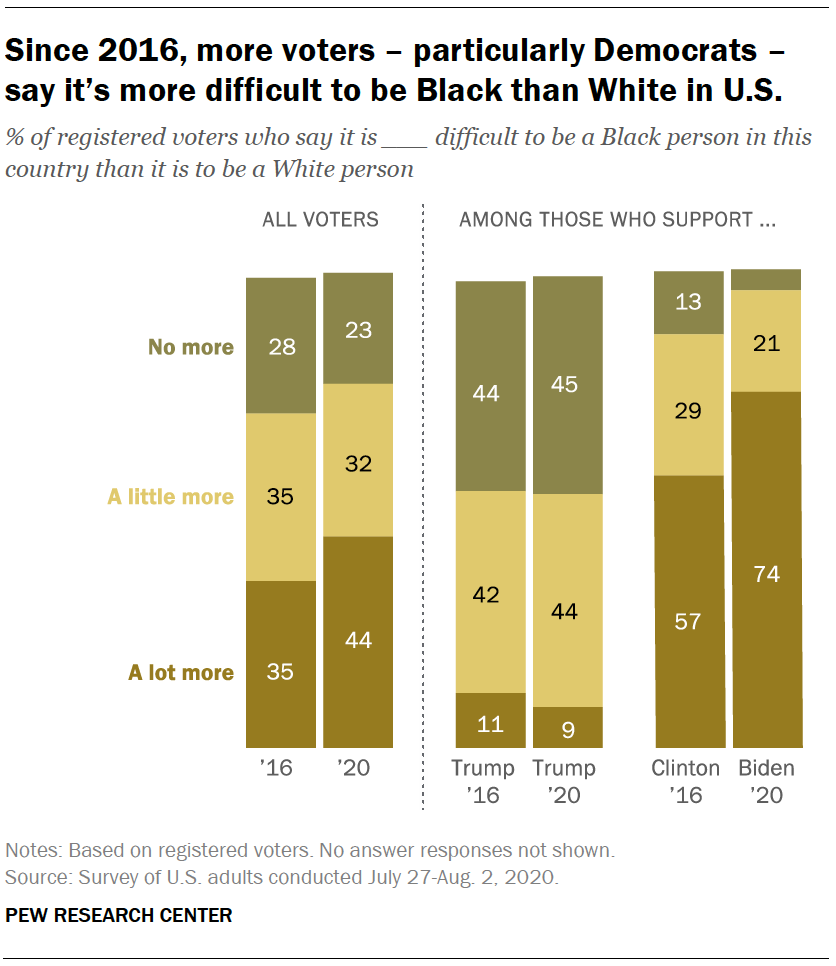 But while overall views take shifted, the shift has come up exclusively from within the Autonomous coalition. The attitudes of Trump supporters today look very similar to attitudes of Trump supporters four years ago: 45% of Trump voters now say that it is no more difficult to be a Blackness person in the U.S. than to exist a White person, while 44% say Black people accept it a piddling more difficult. But about i-in-ten Trump supporters say that Black people have it a lot more hard than White people.
Biden's backers, on the other hand, are substantially more likely today than Clinton'due south backers were in 2016 to say that it is a lot more difficult to be Black than White (74% today vs. 57% in 2016).
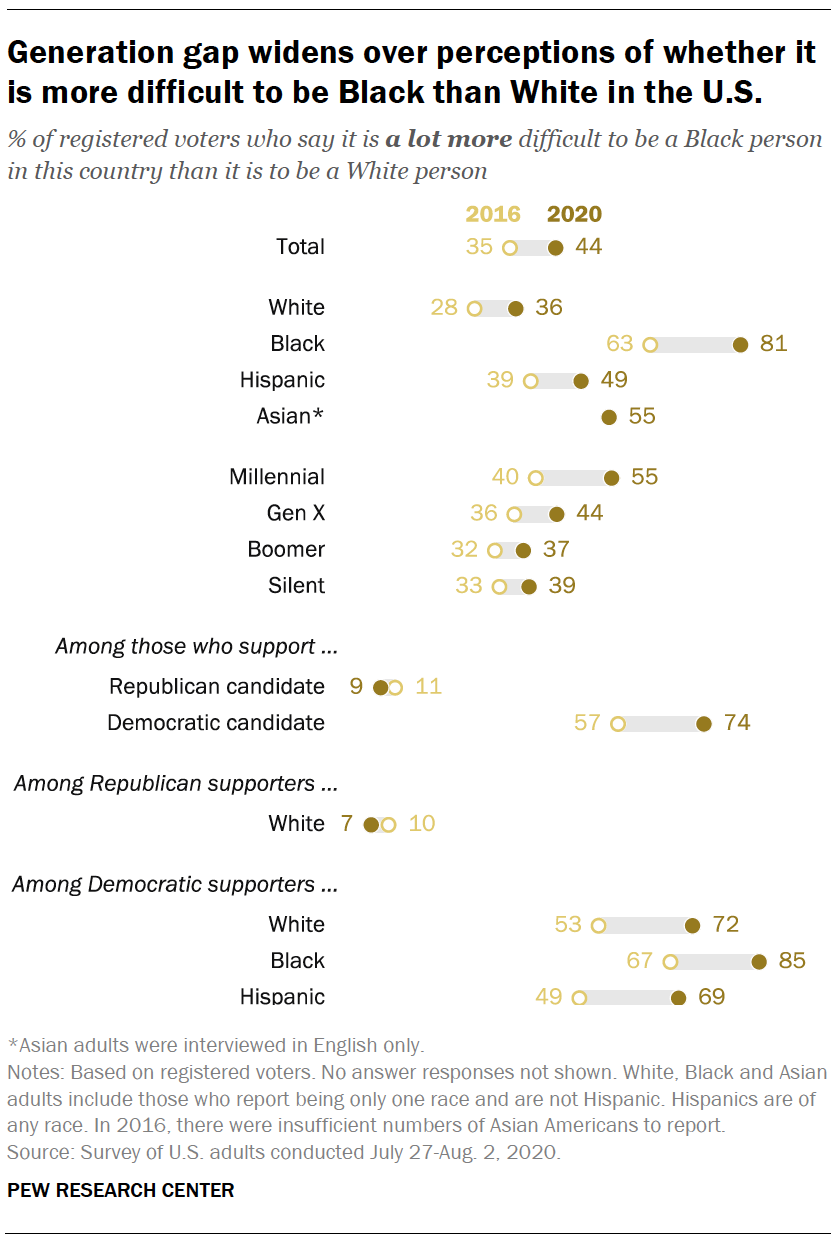 Younger cohorts and those who back up Democratic candidates for president take shifted most in these views over the by four years. White voters and those who support Trump have moved least.
In 2016, in that location were just small-scale generational differences on the question of whether it is more difficult to exist Black than White. There is currently a wider generational gap on this question – with a bulk of Millennial voters (55%) maxim this compared with 44% of Generation X voters, 37% of Boomer voters and 39% of Silent Generation voters.
Across racial and ethnic groups, growing shares now say information technology is more hard to exist Black than White in the land, though the overall change is more pronounced amid Black voters than White or Hispanic voters. However, this largely reflects the partisan leanings of these groups. Inside the Democratic coalition the shift has been similar beyond racial and ethnic groups.
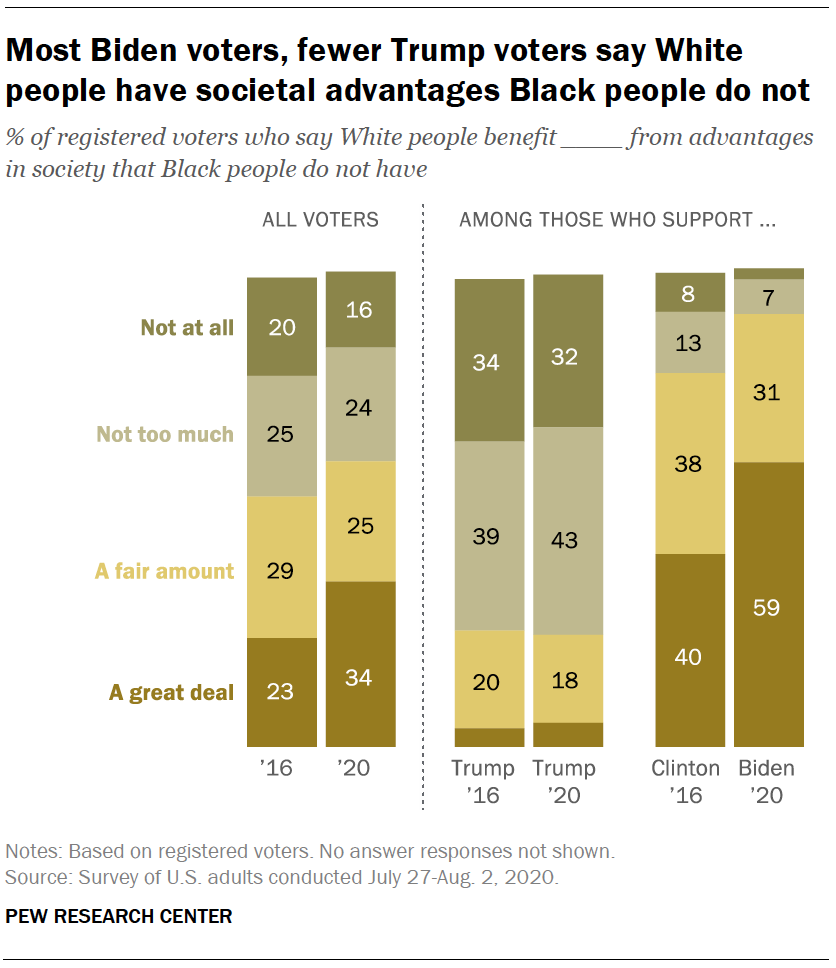 The pattern of opinion on the question of whether White people benefit from societal advantages Black people do not have is largely parallel, with a larger share of voters now maxim that White people benefit a great deal from advantages in social club that Black people don't have. While Biden's supporters are substantially more probable to say that White people have advantages than Clinton supporters were in 2016 (59% today, 40% then), just 5% of Trump supporters say this today – little different than the 4% who said this in 2016.
Though both Black and White voters are now more likely to say White people benefit from societal advantages than they were in 2016, there remain wide racial differences in these views – even taking partisanship into business relationship. About eight-in-10 Blackness Biden voters (81%) say White people benefit a great deal from advantages that Blackness people don't have, up from 64% among Clinton's Black supporters in 2016. By comparison, about half (51%) of White Biden supporters currently say this, up from 29% among White Clinton supporters in 2016.
Views about gender and family unit increasingly split the coalitions
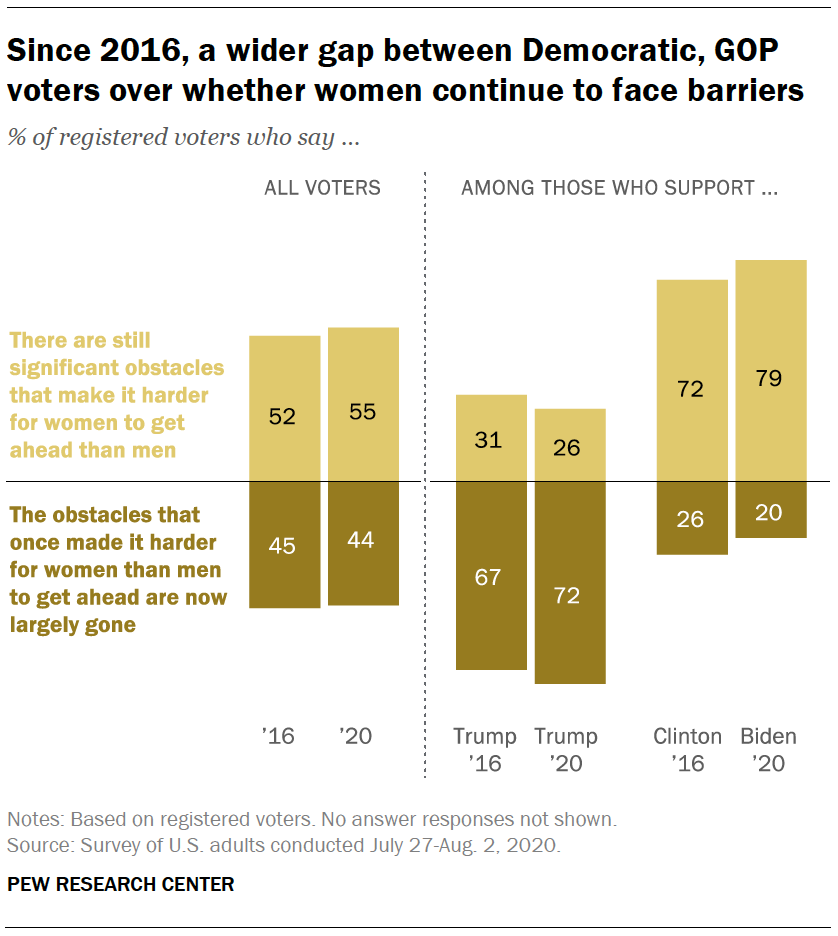 Overall, a narrow majority of voters say that women today nevertheless face significant obstacles that brand it harder for them to get ahead than men (55%), while fewer (44%) say that obstacles that in one case made information technology harder for women to get ahead are now largely gone.
These overall views are little inverse from 2016, simply the already wide gap between the Autonomous and Republican coalitions is now even wider.
Today, 72% of Trump voters say that obstacles that in one case made it harder for women are now largely gone, up from 67% in 2016. By contrast, only twenty% of Biden voters currently say this – a modest decline from the 26% among Clinton voters in 2016.
Women supporters of each candidate remain somewhat more than likely than men to say that significant obstacles even so exist for women, only the political divide in these views is far greater than the gender gap.
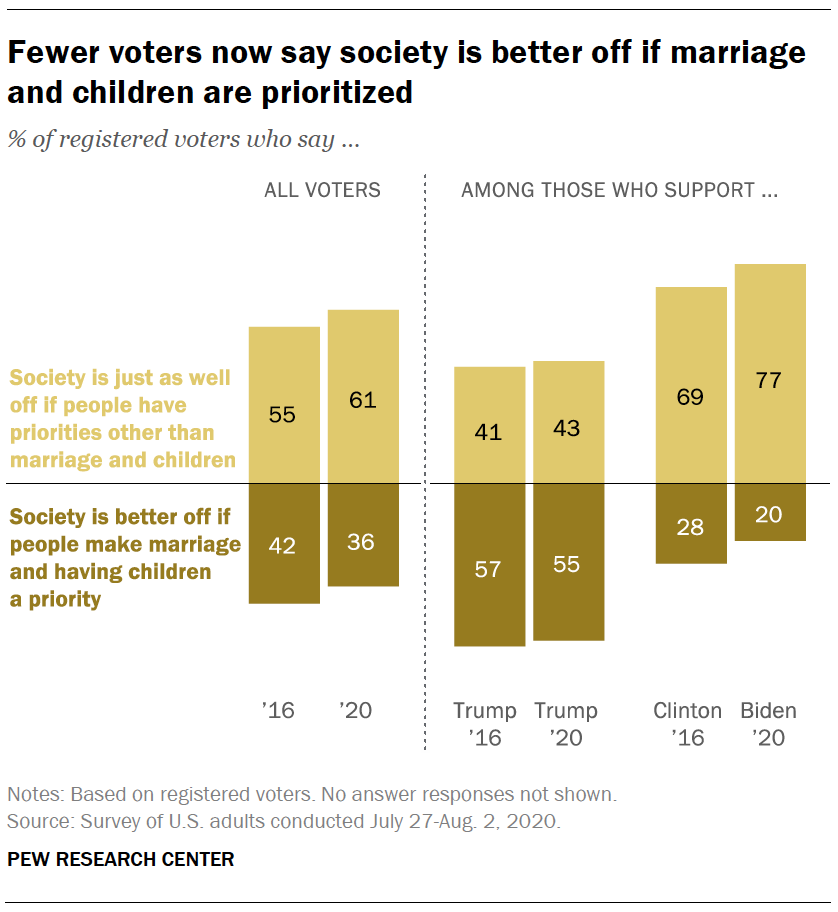 When asked virtually societal priorities around family, voters are somewhat less likely to say that society is better off if people brand marriage and having children a priority than they were four years ago (36% today, 42% in 2016). As was the case in 2016, a slim majority of Trump's voters this year say this (55% today, 57% in 2016). Only Biden voters are slightly more likely today to say that society is only equally well off if people have priorities other than union and children than Clinton voters were in 2016 (77% today, 69% in 2016).
 In 2016, some of the largest result divides between Trump and Clinton supporters were around attitudes nigh the nation's growing racial and ethnic diverseness and immigration. These views had been some of the key distinguishing characteristics of Trump's strongest supporters in his path to the GOP nomination earlier that yr.
As in 2016, there continue to be stark differences in these views – simply these gaps have not been growing, and voters across the political spectrum have shifted in a more than liberal direction in this domain.
In 2016 voters were about evenly divided in the share proverb that the growing number of newcomers strengthens American gild (46%) and the share who said they threaten traditional American customs and values (50%). Today, six-in-ten American voters (lx%) say that newcomers strengthen American order and 37% say they threaten traditional community and values.
Supporters of both major political party candidates this year are more likely than 2016 supporters to have positive views of immigrants to the United States, but the gap between supporters of the Republican and Democratic candidates is little different than it was four years ago. Today, more eight-in-10 Biden supporters (84%) say the growing share of newcomers in the U.S. strengthens American society, up from 71% among Clinton supporters in 2016. By comparison, a much smaller share of Trump supporters (32%) view clearing as strengthening society. Still, that is upward from simply nineteen% amid Trump supporters in 2016.
Views of Islam largely divide the Trump-Biden coalitions
 The trajectory on views virtually Islam is similar to that of newcomers from away.
Four years ago, a narrow majority (54%) of voters said that Islam was more likely than other religions to encourage violence among its followers. Today, the balance of opinion has shifted in the other management, with 45% of voters saying that Islam is more probable to encourage violence and 51% maxim information technology does not encourage violence more than than other religions.
As was the case with attitudes about immigration, the gulf betwixt Trump voters and Biden voters remains equally wide equally it was 4 years ago betwixt supporters of Clinton and Trump, even as views in both coalitions have shifted.
Today, roughly three-quarters of Biden backers (74%) say Islam does not encourage violence more than than other religions, upwards from 63% of Clinton's supporters in 2016.
Past contrast, simply 23% of Trump's supporters reject the assertion that Islam is more than encouraging of violence than other religions, while 72% say Islam is more likely to encourage violence than other religions. In 2016, fully lxxx% of Trump supporters said Islam encouraged more than violence.
Source: https://www.pewresearch.org/politics/2020/09/10/voters-attitudes-about-race-and-gender-are-even-more-divided-than-in-2016/
Posted by: pantonemenim69.blogspot.com
0 Response to "What Is Racial Makeup Of Trump Supporters"
Post a Comment