

What Is The Current Party Makeup Of The Senate
Coordinates: 38°53′26″N 77°0′32″W / 38.89056°North 77.00889°W / 38.89056; -77.00889
| United states of america Senate | |
|---|---|
| 117th United States Congress | |
 Seal of the U.S. Senate | |
 Flag of the U.S. Senate | |
| Type | |
| Type | Upper business firm of the United States Congress |
| Term limits | None |
| History | |
| New session started | January 3, 2021 (2021-01-03) |
| Leadership | |
| President of the Senate | Kamala Harris (D) |
| President pro tempore | Patrick Leahy (D) |
| Majority Leader | Chuck Schumer (D) |
| Minority Leader | Mitch McConnell (R) |
| Majority Whip | Dick Durbin (D) |
| Minority Whip | John Thune (R) |
| Construction | |
| Seats | 100 51 (or fifty plus the Vice President) for a bulk |
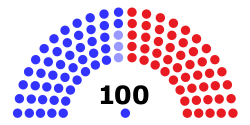 | |
| Political groups | Bulk (50) [a]
Minority (50)
|
| Length of term | six years |
| Elections | |
| Voting system | Plurality voting in 46 states[c] Varies in 4 states
|
| Last election | Nov 3, 2020[d] (35 seats) |
| Next election | November viii, 2022 (35 seats) |
| Coming together identify | |
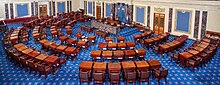 | |
| Senate Chamber U.s. Capitol Washington, D.C. United States | |
| Website | |
| senate.gov | |
| Constitution | |
| United states Constitution | |
| Rules | |
| Standing Rules of the United States Senate | |
The United States Senate is the upper chamber of the United States Congress, with the House of Representatives being the lower bedchamber. Together they compose the national bicameral legislature of the U.s..
The composition and powers of the Senate are established by Commodity 1 of the United States Constitution.[2] The Senate is composed of senators, each of whom represents a unmarried state in its entirety. Each country is equally represented by two senators who serve staggered terms of six years. There are currently 100 senators representing the fifty states. The vice president of the United States serves as presiding officeholder and president of the Senate by virtue of that office, and has a vote but if the senators are equally divided. In the vice president's absence, the president pro tempore, who is traditionally the senior member of the party holding a bulk of seats, presides over the Senate.
Every bit the upper sleeping accommodation of Congress, the Senate has several powers of advice and consent which are unique to it. These include the approval of treaties, and the confirmation of Cabinet secretaries, federal judges (including Federal Supreme Court justices), flag officers, regulatory officials, ambassadors, other federal executive officials and federal uniformed officers. If no candidate receives a bulk of electors for vice president, the duty falls to the Senate to elect one of the tiptop two recipients of electors for that role. The Senate conducts trials of those impeached by the House.
The Senate is widely considered both a more deliberative[iii] and more prestigious[four] [v] [half dozen] body than the House of Representatives due to its longer terms, smaller size, and statewide constituencies, which historically led to a more collegial and less partisan atmosphere.[7]
From 1789 to 1913, senators were appointed by legislatures of us they represented. They are at present elected by popular vote following the ratification of the Seventeenth Amendment in 1913. In the early 1920s, the practice of majority and minority parties electing their floor leaders began. The Senate's legislative and executive business is managed and scheduled past the Senate majority leader.
The Senate chamber is located in the north wing of the Capitol Building in Washington, D.C.
History
The drafters of the Constitution created a bicameral Congress primarily every bit a compromise between those who felt that each state, since information technology was sovereign, should be equally represented, and those who felt the legislature must directly correspond the people, every bit the Firm of Eatables did in U.k.. This idea of having i sleeping room represent people every bit, while the other gives equal representation to states regardless of population, was known equally the Connecticut Compromise. There was also a want to have two Houses that could deed as an internal check on each other. One was intended to exist a "People's House" directly elected by the people, and with short terms obliging the representatives to remain close to their constituents. The other was intended to represent the states to such extent as they retained their sovereignty except for the powers expressly delegated to the national authorities. The Constitution provides that the approval of both chambers is necessary for the passage of legislation.[8]
First convened in 1789, the Senate of the U.s. was formed on the case of the aboriginal Roman Senate. The name is derived from the senatus, Latin for council of elders (from senex meaning old man in Latin).[nine]
James Madison made the following comment well-nigh the Senate:
In England, at this day, if elections were open to all classes of people, the belongings of landed proprietors would be insecure. An agrarian law would soon take place. If these observations remain just, our government ought to secure the permanent interests of the land against innovation. Landholders ought to have a share in the authorities, to support these invaluable interests, and to balance and cheque the other. They ought to exist so constituted as to protect the minority of the opulent against the majority. The Senate, therefore, ought to exist this body; and to answer these purposes, they ought to have permanency and stability.[10]
—Notes of the Hole-and-corner Debates of the Federal Convention of 1787
Article 5 of the Constitution stipulates that no constitutional amendment may be created to deprive a country of its equal suffrage in the Senate without that state's consent. The Commune of Columbia and all other territories are not entitled to representation or allowed to vote in either firm of Congress. They have official non-voting delegates in the House of Representatives, only none in the Senate. The District of Columbia and Puerto Rico each additionally elect 2 "shadow senators", but they are officials of their corresponding local governments and non members of the U.Southward. Senate.[eleven] The Us has had 50 states since 1959,[12] thus the Senate has had 100 senators since 1959.[8]

Graph showing historical party control of the U.S. Senate, House and Presidency since 1855[thirteen]
The disparity between the most and to the lowest degree populous states has grown since the Connecticut Compromise, which granted each land 2 members of the Senate and at least one member of the Firm of Representatives, for a full minimum of three presidential electors, regardless of population. In 1787, Virginia had roughly 10 times the population of Rhode Island, whereas today California has roughly lxx times the population of Wyoming, based on the 1790 and 2020 censuses. Before the adoption of the Seventeenth Amendment in 1913, senators were elected by the individual country legislatures.[14] Problems with repeated vacant seats due to the inability of a legislature to elect senators, intrastate political struggles, bribery and intimidation gradually led to a growing movement to improve the Constitution to let for the direct election of senators.[fifteen]
Current limerick and election results

Members of the United states Senate for the 117th Congress
Current party standings
The party limerick of the Senate during the 117th Congress:
| Affiliation | Members | |
|---|---|---|
| Republican | 50 | |
| Democratic | 48 | |
| Independents | two[b] | |
| Total | 100 | |
Membership
Qualifications
Article I, Section 3, of the Constitution, sets 3 qualifications for senators: (1) they must be at least 30 years old; (2) they must have been citizens of the Us for at least 9 years; and (3) they must exist inhabitants of the states they seek to represent at the time of their election. The historic period and citizenship qualifications for senators are more stringent than those for representatives. In Federalist No. 62, James Madison justified this arrangement by arguing that the "senatorial trust" called for a "greater extent of information and stability of character":
A senator must be thirty years of historic period at least; equally a representative must be xx-v. And the quondam must have been a citizen 9 years; as seven years are required for the latter. The propriety of these distinctions is explained by the nature of the senatorial trust, which, requiring greater extent of information and stability of grapheme, requires at the aforementioned time that the senator should have reached a flow of life most probable to supply these advantages; and which, participating immediately in transactions with foreign nations, ought to be exercised by none who are not thoroughly weaned from the prepossessions and habits incident to strange birth and education. The term of nine years appears to be a prudent mediocrity betwixt a total exclusion of adopted citizens, whose merits and talents may merits a share in the public confidence, and an indiscriminate and hasty admission of them, which might create a channel for foreign influence on the national councils.[16]
The Senate (not the judiciary) is the sole judge of a senator's qualifications. During its early years, yet, the Senate did non closely scrutinize the qualifications of its members. As a outcome, 4 senators who failed to run into the historic period requirement were all the same admitted to the Senate: Henry Dirt (anile 29 in 1806), John Hashemite kingdom of jordan Crittenden (aged 29 in 1817), Armistead Thomson Mason (aged 28 in 1816), and John Eaton (aged 28 in 1818). Such an occurrence, however, has not been repeated since.[17] In 1934, Rush D. Holt Sr. was elected to the Senate at the age of 29; he waited until he turned xxx (on the next June nineteen) to take the oath of office. In Nov 1972, Joe Biden was elected to the Senate at the age of 29, only he reached his 30th altogether before the swearing-in ceremony for incoming senators in January 1973.
The Fourteenth Amendment to the United States Constitution disqualifies as senators any federal or state officers who had taken the requisite oath to support the Constitution only who later engaged in rebellion or aided the enemies of the The states. This provision, which came into force shortly afterward the end of the Ceremonious War, was intended to forbid those who had sided with the Confederacy from serving. That Subpoena, withal, as well provides a method to remove that disqualification: a 2-thirds vote of both chambers of Congress.
Elections and term
Originally, senators were selected by the state legislatures, not past pop elections. By the early on years of the 20th century, the legislatures of as many as 29 states had provided for popular ballot of senators by referendums.[15] Popular election to the Senate was standardized nationally in 1913 by the ratification of the Seventeenth Amendment.
Term
Senators serve terms of 6 years each; the terms are staggered so that approximately ane-3rd of the seats are up for election every two years. This was accomplished by dividing the senators of the 1st Congress into thirds (called classes), where the terms of ane-3rd expired later on two years, the terms of another tertiary expired afterwards iv, and the terms of the concluding 3rd expired after 6 years. This organization was also followed later on the access of new states into the marriage. The staggering of terms has been arranged such that both seats from a given state are not contested in the aforementioned general election, except when a vacancy is being filled. Current senators whose 6-year terms are set to expire on January three, 2023, belong to Grade III. There is no ramble limit to the number of terms a senator may serve.
The Constitution set the date for Congress to convene — Commodity 1, Section 4, Clause 2, originally fix that appointment for the third twenty-four hours of Dec. The Twentieth Amendment, however, changed the opening date for sessions to noon on the third twenty-four hour period of Jan, unless they shall by constabulary appoint a different day. The Twentieth Amendment besides states that the Congress shall assemble at to the lowest degree once every twelvemonth, and allows the Congress to determine its convening and adjournment dates and other dates and schedules equally it desires. Article 1, Department 3, provides that the president has the power to convene Congress on boggling occasions at his discretion.[18]
A member who has been elected, merely non yet seated, is chosen a senator-elect; a member who has been appointed to a seat, simply non yet seated, is chosen a senator-designate.
Elections
Elections to the Senate are held on the first Tuesday after the first Monday in November in fifty-fifty-numbered years, Election Day, and coincide with elections for the Firm of Representatives.[19] Senators are elected by their state as a whole. The Elections Clause of the United States Constitution grants each state (and Congress, if it and then desires to implement a uniform law) the power to legislate a method by which senators are elected. Ballot access rules for independent and minor party candidates also vary from state to state.
In 45 states, a primary ballot is held first for the Republican and Democratic parties (and a select few third parties, depending on the state) with the full general election following a few months later. In most of these states, the nominee may receive only a plurality, while in some states, a runoff is required if no majority was achieved. In the general election, the winner is the candidate who receives a plurality of the pop vote.
However, in five states, different methods are used. In Georgia, a runoff between the pinnacle two candidates occurs if the plurality winner in the general election does not likewise win a majority. In California, Washington, and Louisiana, a nonpartisan coating primary (also known as a "jungle chief" or "peak-ii primary") is held in which all candidates participate in a unmarried primary regardless of party amalgamation and the tiptop two candidates in terms of votes received at the master election advance to the general election, where the winner is the candidate with the greater number of votes. In Louisiana, the blanket principal is considered the full general ballot and candidates receiving a majority of the votes is alleged the winner, skipping a run-off. In Maine and Alaska, ranked-pick voting is used to nominate and elect candidates for federal offices, including the Senate.[twenty]
Vacancies
The Seventeenth Amendment requires that vacancies in the Senate exist filled by special election. Whenever a senator must exist appointed or elected, the secretarial assistant of the Senate mails one of iii forms to the state'due south governor to inform them of the proper wording to certify the appointment of a new senator.[21] If a special election for one seat happens to coincide with a general election for the land'south other seat, each seat is contested separately. A senator elected in a special ballot takes office equally before long every bit possible after the election and serves until the original six-year term expires (i.eastward. not for a full-term).
The Seventeenth Amendment permits state legislatures to empower their governors to make temporary appointments until the required special election takes place.
The manner by which the Seventeenth Subpoena is enacted varies among usa. A 2018 report breaks this downward into the following three broad categories (specific procedures vary among the states):[22]
- Five states – North Dakota, Oklahoma, Oregon, Rhode Island, and Wisconsin – practice not empower their governors to make temporary appointments, relying exclusively on the required special election provision in the Seventeenth Subpoena.[22] : 7–8
- Nine states – Alabama, Alaska, Connecticut, Louisiana, Massachusetts, Mississippi, Texas, Vermont, and Washington – provide for gubernatorial appointments, merely as well require a special election on an accelerated schedule.[22] : 10–11
- The remaining thirty-half dozen states provide for gubernatorial appointments, "with the appointed senator serving the balance of the term or until the next statewide general election".[22] : 8–9
In 6 states within the final category above – Arizona, Hawaii, Maryland, North Carolina, Utah, and Wyoming – the governor must appoint someone of the same political party equally the previous incumbent.[22] : 9
In September 2009, Massachusetts inverse its law to enable the governor to appoint a temporary replacement for the belatedly senator Edward Kennedy until the special election in January 2010.[23] [24]
In 2004, Alaska enacted legislation and a carve up ballot referendum that took event on the same 24-hour interval, but that conflicted with each other. The effect of the ballot-approved law is to withhold from the governor authority to appoint a senator.[25] Because the 17th Amendment vests the power to grant that authority to the legislature – not the people or the state by and large – information technology is unclear whether the ballot measure supplants the legislature's statute granting that authority.[25] Equally a outcome, information technology is uncertain whether an Alaska governor may appoint an interim senator to serve until a special election is held to fill the vacancy.
Oath
The Constitution requires that senators take an adjuration or affidavit to support the Constitution.[26] Congress has prescribed the following oath for all federal officials (except the President), including senators:
I, ___ ___, practise solemnly swear (or affirm) that I will support and defend the Constitution of the United States against all enemies, foreign and domestic; that I volition carry true religion and allegiance to the same; that I have this obligation freely, without whatsoever mental reservation or purpose of evasion; and that I volition well and faithfully belch the duties of the office on which I am about to enter. And so help me God.[27]
Salary and benefits
The annual salary of each senator, since 2009, is $174,000;[28] the president pro tempore and party leaders receive $193,400.[28] [29] In June 2003, at least 40 senators were millionaires;[30] in 2018, over fifty senators were millionaires.[31]
Forth with earning salaries, senators receive retirement and health benefits that are identical to other federal employees, and are fully vested later on five years of service.[29] Senators are covered by the Federal Employees Retirement System (FERS) or Civil Service Retirement Arrangement (CSRS). FERS has been the Senate's retirement system since Jan i, 1987, while CSRS applies only for those senators who were in the Senate from December 31, 1986, and prior. Equally it is for federal employees, congressional retirement is funded through taxes and the participants' contributions. Under FERS, senators contribute 1.three% of their bacon into the FERS retirement plan and pay 6.two% of their salary in Social Security taxes. The amount of a senator'south pension depends on the years of service and the average of the highest iii years of their salary. The starting corporeality of a senator's retirement annuity may not exceed 80% of their final bacon. In 2006, the average annual alimony for retired senators and representatives under CSRS was $threescore,972, while those who retired under FERS, or in combination with CSRS, was $35,952.[29]
Seniority
Seniority is a factor in the selection of concrete offices and in party caucuses' assignment of committees.[32]
Expulsion and other disciplinary deportment
The Senate may expel a senator past a two-thirds vote. Xv senators have been expelled in the Senate'southward history: William Blount, for treason, in 1797, and 14 in 1861 and 1862 for supporting the Confederate secession. Although no senator has been expelled since 1862, many senators have chosen to resign when faced with expulsion proceedings – for example, Bob Packwood in 1995. The Senate has also censured and condemned senators; censure requires but a simple majority and does not remove a senator from office. Some senators have opted to withdraw from their re-election races rather than face certain censure or expulsion, such as Robert Torricelli in 2002.
Bulk and minority parties
The "majority political party" is the political political party that either has a majority of seats or can course a coalition or conclave with a majority of seats; if ii or more parties are tied, the vice president'south affiliation determines which party is the majority party. The side by side-largest party is known equally the minority party. The president pro tempore, committee chairs, and some other officials are generally from the majority party; they have counterparts (for instance, the "ranking members" of committees) in the minority party. Independents and members of 3rd parties (so long as they do not conclave support either of the larger parties) are not considered in determining which is the majority party.
Seating
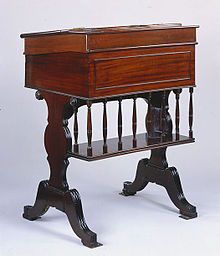
At ane stop of the bedroom of the Senate is a dais from which the presiding officer presides. The lower tier of the dais is used past clerks and other officials. One hundred desks are arranged in the chamber in a semicircular pattern and are divided by a wide key aisle. The Democratic Political party traditionally sits to the presiding officer'southward correct, and the Republican Party traditionally sits to the presiding officer'southward left, regardless of which political party has a bulk of seats.[33]
Each senator chooses a desk based on seniority within the party. Past custom, the leader of each party sits in the front row along the center alley. Forty-viii of the desks date back to 1819, when the Senate bedroom was reconstructed after the original contents were destroyed in the 1812 Burning of Washington. Further desks of similar design were added as new states entered the Wedlock.[34] Information technology is a tradition that each senator who uses a desk inscribes their name on the inside of the desk's drawer.[35]
Officers

Except for the president of the Senate (who is the vice president), the Senate elects its ain officers,[2] who maintain order and decorum, manage and schedule the legislative and executive business of the Senate, and translate the Senate's rules, practices and precedents. Many non-fellow member officers are as well hired to run various day-to-day functions of the Senate.
Presiding officeholder
Under the Constitution, the vice president serves equally president of the Senate. They may vote in the Senate (ex officio, for they are not an elected member of the Senate) in the case of a tie, but are not required to.[36] For much of the nation's history the task of presiding over Senate sessions was one of the vice president's principal duties (the other being to receive from u.s.a. the tally of electoral ballots cast for president and vice president and to open the certificates "in the Presence of the Senate and House of Representatives", and so that the total votes could be counted). Since the 1950s, vice presidents have presided over few Senate debates. Instead, they have unremarkably presided only on formalism occasions, such as swearing in new senators, joint sessions, or at times to announce the result of meaning legislation or nomination, or when a tie vote on an important issue is anticipated.
The Constitution authorizes the Senate to elect a president pro tempore (Latin for "president for a time"), who presides over the chamber in the vice president'southward absence and is, by custom, the senator of the majority political party with the longest tape of continuous service.[37] Like the vice president, the president pro tempore does not usually preside over the Senate, but typically delegates the responsibility of presiding to a bulk-party senator who presides over the Senate, normally in blocks of one 60 minutes on a rotating basis. Frequently, freshmen senators (newly elected members) are asked to preside then that they may become accepted to the rules and procedures of the body. It is said that, "in practise they are normally mere mouthpieces for the Senate'due south parliamentarian, who whispers what they should exercise".[38]
The presiding officer sits in a chair in the front end of the Senate chamber. The powers of the presiding officer of the Senate are far less extensive than those of the speaker of the House. The presiding officer calls on senators to speak (past the rules of the Senate, the offset senator who rises is recognized); ruling on points of club (objections by senators that a rule has been breached, subject area to appeal to the whole bedroom); and announcing the results of votes.
Party leaders
Each party elects Senate party leaders. Floor leaders act as the party primary spokesmen. The Senate bulk leader is responsible for controlling the agenda of the chamber by scheduling debates and votes. Each party elects an banana leader (whip), who works to ensure that his political party's senators vote as the party leadership desires.
Non-member officers
In add-on to the vice president, the Senate has several officers who are non members. The Senate's chief authoritative officer is the secretarial assistant of the Senate, who maintains public records, disburses salaries, monitors the acquisition of jotter and supplies, and oversees clerks. The assistant secretary of the Senate aids the secretary's work. Another official is the sergeant at artillery who, equally the Senate'due south chief law enforcement officer, maintains order and security on the Senate premises. The Capitol Police handle routine police force work, with the sergeant at arms primarily responsible for general oversight. Other employees include the clergyman, who is elected past the Senate, and pages, who are appointed.
Procedure
Daily sessions
The Senate uses Standing Rules for operation. Similar the House of Representatives, the Senate meets in the United States Capitol in Washington, D.C. At one finish of the bedroom of the Senate is a dais from which the presiding officeholder presides. The lower tier of the dais is used by clerks and other officials. Sessions of the Senate are opened with a special prayer or invocation and typically convene on weekdays. Sessions of the Senate are mostly open to the public and are broadcast live on television, usually by C-SPAN 2.
Senate process depends non only on the rules, merely also on a variety of community and traditions. The Senate commonly waives some of its stricter rules past unanimous consent. Unanimous consent agreements are typically negotiated beforehand by party leaders. A senator may block such an agreement, but in do, objections are rare. The presiding officer enforces the rules of the Senate, and may warn members who deviate from them. The presiding officeholder sometimes uses the gavel of the Senate to maintain club.
A "concur" is placed when the leader'southward office is notified that a senator intends to object to a asking for unanimous consent from the Senate to consider or pass a measure. A hold may be placed for any reason and can be lifted past a senator at any time. A senator may identify a hold merely to review a neb, to negotiate changes to the bill, or to impale the bill. A bill can exist held for every bit long as the senator who objects to the bill wishes to cake its consideration.
Holds can be overcome, just require time-consuming procedures such equally filing cloture. Holds are considered private communications between a senator and the leader, and are sometimes referred to as "secret holds". A senator may disembalm the placement of a agree.
The Constitution provides that a majority of the Senate constitutes a quorum to exercise business organization. Under the rules and customs of the Senate, a quorum is always assumed nowadays unless a quorum call explicitly demonstrates otherwise. A senator may request a quorum call past "suggesting the absence of a quorum"; a clerk then calls the roll of the Senate and notes which members are present. In practise, senators rarely request quorum calls to institute the presence of a quorum. Instead, quorum calls are more often than not used to temporarily delay proceedings; unremarkably, such delays are used while waiting for a senator to achieve the floor to speak or to give leaders time to negotiate. Once the need for a delay has ended, a senator may request unanimous consent to rescind the quorum call.
Fence
Debate, like almost other matters governing the internal functioning of the Senate, is governed by internal rules adopted past the Senate. During a debate, senators may merely speak if chosen upon past the presiding officer, but the presiding officeholder is required to recognize the start senator who rises to speak. Thus, the presiding officer has niggling command over the form of the debate. Customarily, the majority leader and minority leader are accorded priority during debates fifty-fifty if another senator rises first. All speeches must be addressed to the presiding officer, who is addressed every bit "Mr. President" or "Madam President", and not to another fellow member; other Members must exist referred to in the third person. In most cases, senators practise not refer to each other past proper name, just by state or position, using forms such every bit "the senior senator from Virginia", "the gentleman from California", or "my distinguished friend the chairman of the Judiciary Committee". Senators address the Senate standing adjacent to their desks.[39]
Apart from rules governing civility, at that place are few restrictions on the content of speeches; there is no requirement that speeches pertain to the matter before the Senate.
The rules of the Senate provide that no senator may make more than two speeches on a motion or beak on the aforementioned legislative twenty-four hours. A legislative solar day begins when the Senate convenes and ends with banishment; hence, it does not necessarily coincide with the agenda day. The length of these speeches is not limited by the rules; thus, in well-nigh cases, senators may speak for as long equally they delight. Oftentimes, the Senate adopts unanimous consent agreements imposing time limits. In other cases (for case, for the upkeep process), limits are imposed past statute. Nonetheless, the right to unlimited debate is generally preserved.
Within the The states, the Senate is sometimes referred to as "world's greatest deliberative body".[40] [41] [42]
Filibuster and cloture
The filibuster is a tactic used to defeat bills and motions by prolonging fence indefinitely. A filibuster may entail long speeches, dilatory motions, and an extensive series of proposed amendments. The Senate may end a filibuster by invoking cloture. In almost cases, cloture requires the support of three-fifths of the Senate; however, if the affair before the Senate involves changing the rules of the torso – this includes alteration provisions regarding the filibuster – a two-thirds majority is required. In current exercise, the threat of filibuster is more important than its use; almost whatever move that does non take the back up of iii-fifths of the Senate finer fails. This means that 41 senators can make a delay happen. Historically, cloture has rarely been invoked because bipartisan support is usually necessary to obtain the required supermajority, so a nib that already has bipartisan support is rarely subject to threats of filibuster. Notwithstanding, motions for cloture take increased significantly in recent years.
If the Senate invokes cloture, the fence does not necessarily terminate immediately; instead, it is limited to up to thirty additional hours unless increased by some other three-fifths vote. The longest filibuster speech in the Senate's history was delivered by Strom Thurmond (D-SC), who spoke for over 24 hours in an unsuccessful attempt to block the passage of the Civil Rights Act of 1957.[43]
Nether sure circumstances, the Congressional Upkeep Deed of 1974 provides for a process chosen "reconciliation" by which Congress tin pass bills related to the upkeep without those bills being subject to a filibuster. This is achieved by limiting all Senate floor debate to twenty hours.[44]
Voting
When the debate concludes, the motion in question is put to a vote. The Senate often votes past voice vote. The presiding officer puts the question, and members respond either "Yea/Yes" (in favor of the motion) or "Nay" (against the move). The presiding officeholder then announces the result of the vocalisation vote. A senator, even so, may challenge the presiding officer's cess and request a recorded vote. The request may exist granted simply if it is seconded by one-fifth of the senators nowadays. In practise, even so, senators second requests for recorded votes as a thing of courtesy. When a recorded vote is held, the clerk calls the roll of the Senate in alphabetical lodge; senators respond when their name is called. Senators who were not in the sleeping accommodation when their proper name was chosen may still cast a vote so long equally the voting remains open. The vote is closed at the discretion of the presiding officeholder, but must remain open for a minimum of 15 minutes. A bulk of those voting determines whether the motion carries.[45] If the vote is tied, the vice president, if nowadays, is entitled to cast a tie-breaking vote. If the vice president is not present, the motility fails.[46]
Filibustered bills require a three-fifths majority to overcome the cloture vote (which usually ways sixty votes) and get to the normal vote where a simple majority (usually 51 votes) approves the bill. This has caused some news media to confuse the 60 votes needed to overcome a filibuster with the 51 votes needed to approve a bill, with for example USA Today erroneously stating "The vote was 58–39 in favor of the provision establishing concealed carry permit reciprocity in the 48 states that accept curtained weapons laws. That fell 2 votes short of the threescore needed to approve the measure".[45]
Closed session
On occasion, the Senate may get into what is called a cloak-and-dagger or closed session. During a closed session, the sleeping accommodation doors are closed, cameras are turned off, and the galleries are completely cleared of anyone non sworn to secrecy, not instructed in the rules of the closed session, or not essential to the session. Closed sessions are rare and normally held only when the Senate is discussing sensitive subject matter such as information critical to national security, individual communications from the president, or deliberations during impeachment trials. A senator may call for and force a closed session if the motion is seconded by at least one other fellow member, just an agreement usually occurs beforehand.[47] If the Senate does not approve the release of a underground transcript, the transcript is stored in the Office of Senate Security and ultimately sent to the national archives. The proceedings remain sealed indefinitely until the Senate votes to remove the injunction of secrecy.[48] In 1973, the Firm adopted a dominion that all committee sessions should be open unless a majority on the committee voted for a airtight session.
Calendars
The Senate maintains a Senate Calendar and an Executive Calendar.[49] The former identifies bills and resolutions pending Senate floor actions. The latter identifies executive resolutions, treaties, and nominations reported out by Senate commission(southward) and awaiting Senate flooring action. Both are updated each day the Senate is in session.
Committees
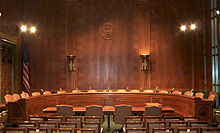
The Senate uses committees (and their subcommittees) for a variety of purposes, including the review of bills and the oversight of the executive branch. Formally, the whole Senate appoints committee members. In do, however, the choice of members is made past the political parties. More often than not, each party honors the preferences of individual senators, giving priority based on seniority. Each party is allocated seats on committees in proportion to its overall strength.
Almost committee work is performed by 16 standing committees, each of which has jurisdiction over a field such every bit finance or strange relations. Each standing committee may consider, ameliorate, and study bills that fall under its jurisdiction. Furthermore, each standing commission considers presidential nominations to offices related to its jurisdiction. (For instance, the Judiciary Commission considers nominees for judgeships, and the Foreign Relations Commission considers nominees for positions in the Department of State.) Committees may cake nominees and impede bills from reaching the floor of the Senate. Standing committees also oversee the departments and agencies of the executive branch. In discharging their duties, standing committees have the ability to hold hearings and to subpoena witnesses and evidence.
The Senate as well has several committees that are not considered continuing committees. Such bodies are generally known every bit select or special committees; examples include the Select Committee on Ideals and the Special Committee on Aging. Legislation is referred to some of these committees, although the bulk of legislative work is performed by the standing committees. Committees may be established on an advertisement hoc footing for specific purposes; for instance, the Senate Watergate Committee was a special committee created to investigate the Watergate scandal. Such temporary committees cease to exist after fulfilling their tasks.
The Congress includes joint committees, which include members from both the Senate and the House of Representatives. Some joint committees oversee contained government bodies; for instance, the Articulation Committee on the Library oversees the Library of Congress. Other joint committees serve to make advisory reports; for instance, there exists a Joint Committee on Taxation. Bills and nominees are not referred to joint committees. Hence, the power of joint committees is considerably lower than those of continuing committees.
Each Senate committee and subcommittee is led past a chair (usually a member of the majority party). Formerly, committee chairs were determined purely by seniority; as a result, several elderly senators continued to serve as chair despite severe physical infirmity or even senility.[l] Committee chairs are elected, just, in do, seniority is rarely bypassed. The chairs concur all-encompassing powers: they command the committee'due south agenda, so decide how much, if whatsoever, time to devote to the consideration of a nib; they act with the ability of the committee in disapproving or delaying a bill or a nomination by the president; they manage on the floor of the full Senate the consideration of those bills the committee reports. This terminal role was particularly important in mid-century, when floor amendments were thought not to exist collegial. They also accept considerable influence: senators who cooperate with their committee chairs are likely to accomplish more skillful for their states than those who do not. The Senate rules and customs were reformed in the twentieth century, largely in the 1970s. Commission chairmen accept less power and are generally more moderate and collegial in exercising information technology, than they were before reform.[51] The 2d-highest member, the spokesperson on the commission for the minority party, is known in most cases as the ranking member.[52] In the Select Committee on Intelligence and the Select Commission on Ethics, notwithstanding, the senior minority fellow member is known as the vice-chair.
Criticism
Contempo criticisms of the Senate's operations object to what the critics argue is obsolescence as a result of partisan paralysis and a preponderance of arcane rules.[53] [54]
The Senate delay is frequently debated. The Constitution specifies a unproblematic bulk threshold to laissez passer legislation, and some critics feel the de facto 3-fifths threshold for general legislation prevents benign laws from passing. (The nuclear option was exercised by both parties in the 2010s to eliminate the delay for confirmations.) Supporters generally consider the delay to be an important protection for the minority views and a bank check against the unfettered single-political party rule when the same party holds the Presidency and a bulk in both the Firm and Senate.
Though this was an intentional part of the Connecticut Compromise, critics have described the fact that representation in the Senate is not proportional to the population as "anti-democratic" and "minority rule".[55] [56] New York Times stance columnist David Leonhardt points out[57] that because small states are disproportionately non-Hispanic European American, African Americans have 75% of their proportionate voting power in the Senate, and Hispanic Americans have simply 55%. The approximately four meg Americans that have no representation in the Senate (in the District of Columbia and U.South. territories) are heavily African and Hispanic American. Leonhardt and others advocate for admitting Washington, D.C. and Puerto Rico as states (both have more residents than the smallest existing states) to reduce this inequity.
Senate office buildings
| External video | |
|---|---|
 Senate Building, Washington DC, HD from 35mm Senate Building, Washington DC, HD from 35mm |
There are presently three Senate function buildings located along Constitution Avenue, north of the Capitol. They are the Russell Senate Office Building, the Dirksen Senate Part Building, and the Hart Senate Office Building.
Functions
Legislation
Bills may be introduced in either chamber of Congress. Even so, the Constitution'south Origination Clause provides that "All bills for raising Acquirement shall originate in the House of Representatives".[58] As a result, the Senate does not have the power to initiate bills imposing taxes. Furthermore, the House of Representatives holds that the Senate does not accept the power to originate cribbing bills, or bills authorizing the expenditure of federal funds.[59] [sixty] [61] [62] Historically, the Senate has disputed the interpretation advocated by the House. However, when the Senate originates an appropriations bill, the Business firm only refuses to consider it, thereby settling the dispute in practice. The ramble provision barring the Senate from introducing revenue bills is based on the practise of the Parliament of the United kingdom, in which money bills canonical past Parliament have originated in the House of Eatables per constitutional convention.[63]
Although the Constitution gave the Business firm the power to initiate revenue bills, in exercise the Senate is equal to the House in the respect of spending. Every bit Woodrow Wilson wrote:
The Senate's right to better general appropriation bills has been immune the widest possible scope. The upper house may add to them what it pleases; may go birthday exterior of their original provisions and tack to them entirely new features of legislation, altering not only the amounts just even the objects of expenditure, and making out of the materials sent them by the pop chamber measures of an almost totally new graphic symbol.[64]
The blessing of both houses is required for any bill, including a revenue neb, to get police. Both Houses must laissez passer the same version of the neb; if there are differences, they may exist resolved past sending amendments back and forth or by a briefing commission, which includes members of both bodies.
Checks and balances
The Constitution provides several unique functions for the Senate that form its power to "check and residual" the powers of other elements of the federal authorities. These include the requirement that the Senate may advise and must consent to some of the president'due south regime appointments; also the Senate must consent to all treaties with foreign governments; it tries all impeachments, and it elects the vice president in the effect no person gets a majority of the balloter votes.
The president can make certain appointments only with the advice and consent of the Senate. Officials whose appointments require the Senate'southward approving include members of the Cabinet, heads of well-nigh federal executive agencies, ambassadors, justices of the Supreme Courtroom, and other federal judges. Under Commodity Two, Section 2, of the Constitution, a large number of government appointments are subject to potential confirmation; all the same, Congress has passed legislation to qualify the appointment of many officials without the Senate's consent (usually, confirmation requirements are reserved for those officials with the most significant final decision-making authorisation). Typically, a nominee is the first subject to a hearing before a Senate committee. Thereafter, the nomination is considered past the total Senate. The majority of nominees are confirmed, but in a small number of cases each year, Senate committees purposely fail to act on a nomination to block it. In add-on, the president sometimes withdraws nominations when they appear unlikely to be confirmed. Considering of this, outright rejections of nominees on the Senate floor are infrequent (at that place have been only nine Cabinet nominees rejected outright in United States history).[65]
The powers of the Senate concerning nominations are, yet, field of study to some constraints. For example, the Constitution provides that the president may make an date during a congressional recess without the Senate's communication and consent. The recess engagement remains valid only temporarily; the office becomes vacant over again at the end of the next congressional session. Nevertheless, presidents have frequently used recess appointments to circumvent the possibility that the Senate may reject the nominee. Furthermore, as the Supreme Courtroom held in Myers v. United States, although the Senate'due south advice and consent are required for the appointment of certain executive branch officials, it is not necessary for their removal.[66] [67] Recess appointments take faced a significant amount of resistance and in 1960, the U.S. Senate passed a legally non-binding resolution against recess appointments.[ citation needed ]

The Senate as well has a role in ratifying treaties. The Constitution provides that the president may only "brand Treaties, provided 2-thirds of the senators nowadays concur" in guild to benefit from the Senate'south communication and consent and give each land an equal vote in the process. However, not all international agreements are considered treaties nether U.S. domestic law, fifty-fifty if they are considered treaties nether international law. Congress has passed laws authorizing the president to conclude executive agreements without action by the Senate. Similarly, the president may brand congressional-executive agreements with the approval of a simple majority in each House of Congress, rather than a two-thirds majority in the Senate. Neither executive agreements nor congressional-executive agreements are mentioned in the Constitution, leading some scholars such equally Laurence Tribe and John Yoo[68] to propose that they unconstitutionally circumvent the treaty-ratification procedure. However, courts have upheld the validity of such agreements.[69]
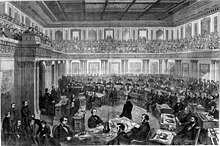
The Constitution empowers the House of Representatives to impeach federal officials for "Treason, Blackmail, or other high Crimes and Misdemeanors" and empowers the Senate to try such impeachments. If the sitting president of the United States is beingness tried, the chief justice of the United states of america presides over the trial. During an impeachment trial, senators are constitutionally required to sit down on adjuration or affirmation. Conviction requires a two-thirds majority of the senators present. A bedevilled official is automatically removed from role; in addition, the Senate may stipulate that the defendant be banned from property part. No further penalisation is permitted during the impeachment proceedings; however, the party may face up criminal penalties in a normal courtroom of law.
The Business firm of Representatives has impeached sixteen officials, of whom vii were convicted (i resigned before the Senate could complete the trial).[70] Only three presidents have been impeached: Andrew Johnson in 1868, Bill Clinton in 1998, and Donald Trump in 2019 and 2021. The trials of Johnson, Clinton and both Trump trials ended in acquittal; in Johnson's case, the Senate vicious one vote brusque of the ii-thirds bulk required for conviction.
Under the Twelfth Amendment, the Senate has the power to elect the vice president if no vice-presidential candidate receives a majority of votes in the Balloter College. The Twelfth Amendment requires the Senate to choose from the two candidates with the highest numbers of electoral votes. Electoral College deadlocks are rare. The Senate has only broken a deadlock once; in 1837, it elected Richard Mentor Johnson. The Firm elects the president if the Electoral College deadlocks on that option.
See also
- Edward M. Kennedy Constitute for the United States Senate
- Elections in the U.s.
- List of African-American The states senators
- U.s.a. presidents and control of Congress
- Women in the United States Senate
Notes
- ^ Democrats are in the majority due to the tiebreaking ability of Democratic Vice President Kamala Harris, who serves ex officio as the president of the Senate.
- ^ a b The independent senators, Angus King of Maine and Bernie Sanders of Vermont, conclave with the Democrats.[i]
- ^ Alaska (for its master elections simply), California, and Washington additionally utilize a nonpartisan coating primary, and Louisiana uses a Louisiana primary, for their respective chief elections.
- ^ Also the Georgia runoff election and the Georgia special runoff election held on January 5, 2021.
References
- ^ "Maine Independent Angus Male monarch To Caucus With Senate Democrats". Politico. November 14, 2012. Retrieved November 28, 2020.
Angus King of Maine, who cruised to victory last week running as an independent, said Wednesday that he will caucus with Senate Democrats. [...] The Senate's other independent, Bernie Sanders of Vermont, too caucuses with the Democrats.
- ^ a b "Constitution of the United states of america". Senate.gov. March 26, 2009. Retrieved October four, 2010.
- ^ Amar, Vik D. (January 1, 1988). "The Senate and the Constitution". The Yale Law Periodical. 97 (6): 1111–1130. doi:10.2307/796343. JSTOR 796343. S2CID 53702587.
- ^ Stewart, Charles; Reynolds, Marker (Jan 1, 1990). "Television Markets and U.South. Senate Elections". Legislative Studies Quarterly. 15 (four): 495–523. doi:ten.2307/439894. JSTOR 439894.
- ^ Richard L. Berke (September 12, 1999). "In Fight for Control of Congress, Tough Skirmishes Within Parties". The New York Times.
- ^ Joseph South. Friedman (March xxx, 2009). "The Rapid Sequence of Events Forcing the Senate'southward Manus: A Reappraisal of the Seventeenth Amendment, 1890–1913". Curej – College Undergraduate Research Electronic Periodical.
- ^ Lee, Frances E. (June 16, 2006). "Like-minded to Disagree: Agenda Content and Senate Partisanship, 198". Legislative Studies Quarterly. 33 (2): 199–222. doi:10.3162/036298008784311000.
- ^ a b "U.S. Constitution: Article 1, Section 1". Retrieved March 22, 2012.
- ^ "Merriam-Webster's Online Dictionary: senate". Retrieved March 22, 2012.
- ^ Robert Yates. Notes of the Secret Debates of the Federal Convention of 1787 . Retrieved March 17, 2017.
- ^ "Not-voting members of Congress". Archived from the original on November 23, 2010. Retrieved March 22, 2011.
- ^ "Hawaii becomes 50th country". History.com . Retrieved March 22, 2011.
- ^ "Party In Ability – Congress and Presidency – A Visual Guide To The Balance of Power In Congress, 1945–2008". Uspolitics.about.com. Archived from the original on November 1, 2012. Retrieved September 17, 2012.
- ^ Article I, Section 3: "The Senate of the United States shall be composed of two senators from each country, chosen by the legislature thereof, for vi years; each Senator shall take one vote."
- ^ a b "Straight Election of Senators". U.Due south. Senate official website. Retrieved Apr 23, 2019.
- ^ Federalist Papers, No. 62, Library of Congress.
- ^ 1801–1850, Nov 16, 1818: Youngest Senator. United States Senate. Retrieved Nov 17, 2007.
- ^ Dates of Sessions of the Congress. Usa Senate. Retrieved June 17, 2020.
- ^ two U.Southward.C. § 1
- ^ Brooks, James (December xiv, 2020). "Election audit confirms win for Ballot Measure 2 and Alaska's new ranked-choice voting system". Anchorage Daily News . Retrieved Jan 10, 2021.
- ^ "The Term of A Senator – When Does Information technology Brainstorm and End? – Senate 98-29" (PDF). U.s.a. Senate. Usa Printing Part. pp. xiv–xv. Retrieved November 13, 2015.
- ^ a b c d e Neale, Thomas H. (Apr 12, 2018). "U.S. Senate Vacancies: Gimmicky Developments and Perspectives" (PDF). fas.org. Congressional Inquiry Service. Archived (PDF) from the original on June 5, 2018. Retrieved Oct 13, 2018. NOTE: wherever nowadays, references to folio numbers in superscripts refer to the electronic (.pdf) pagination, non every bit establish printed on the lesser margin of displayed pages.
- ^ DeLeo, Robert A. (September 17, 2009). "Temporary Appointment of U.s.a. Senator". Massachusetts Keen and General Court.
- ^ DeLeo, Robert A. (September 17, 2009). "Temporary Engagement of US Senator Shall non be a candidate in special election". Massachusetts Great and General Court.
- ^ a b "Stevens could keep seat in Senate". Anchorage Daily News. October 28, 2009. Archived from the original on May 28, 2009.
- ^ United States Constitution, Commodity Half dozen
- ^ Meet: 5 U.S.C. § 3331; see likewise: U.S. Senate Oath of Role
- ^ a b Salaries. United States Senate. Retrieved October ii, 2013.
- ^ a b c "United states Congress Salaries and Benefits". Usgovinfo.about.com. Retrieved October two, 2013.
- ^ Sean Loughlin and Robert Yoon (June thirteen, 2003). "Millionaires populate U.Due south. Senate". CNN. Retrieved June nineteen, 2006.
- ^ "Wealth of Congress". Curl Call . Retrieved November eight, 2018.
- ^ Bakery, Richard A. "Traditions of the United states of america Senate" (PDF). Page 4.
- ^ "Seating Arrangement". Senate Sleeping accommodation Desks. Retrieved July 11, 2012.
- ^ "Senate Chamber Desks – Overview". United States Senate.
- ^ "Senate Sleeping room Desks – Desk Occupants". United States Senate.
- ^ "Glossary Term: vice president". senate.gov. United States Senate. Retrieved November x, 2016.
- ^ "Glossary Term: president pro tempore". senate.gov. United states of america Senate. Retrieved November ten, 2016.
- ^ Mershon, Erin (August 2011). "Presiding Loses Its Prestige in Senate". Roll Telephone call. rollcall.com. Retrieved February 8, 2017.
- ^ Martin B. Gold, Senate Procedure and Practice, p.39: Every fellow member, when he speaks, shall accost the chair, standing in his place, and when he has finished, shall sit downwards.
- ^ "The World'southward Greatest Deliberative Trunk". Time. July five, 1993. Archived from the original on August xi, 2009.
- ^ "World'south greatest deliberative torso sentry". The Washington Post.
- ^ "Senate reform: Lazing on a Senate afternoon". The Economist . Retrieved October four, 2010.
- ^ Quinton, Jeff. "Thurmond's Filibuster". Backcountry Conservative. July 27, 2003. Retrieved June 19, 2006.
- ^ Reconciliation, (Procedure in the Senate).
- ^ a b "How majority rule works in the U.South. Senate". Nieman Watchdog. July 31, 2009.
- ^ "Yea or Nay? Voting in the Senate". Senate.gov. Retrieved April 11, 2011.
- ^ Amer, Mildred (March 27, 2008). "Secret Sessions of Congress: A Cursory Historical Overview" (PDF). Archived from the original (PDF) on August 6, 2009.
- ^ Amer, Mildred (March 27, 2008). "Secret Sessions of the House and Senate" (PDF). Archived from the original (PDF) on Baronial 6, 2009.
- ^ "Calendars & Schedules" via Senate.gov
- ^ See, for examples, American Lexicon of National Biography on John Sherman and Carter Glass; in general, Ritchie, Congress, p. 209
- ^ Ritchie, Congress, p. 44. Zelizer, On Capitol Hill describes this procedure; one of the reforms is that seniority within the majority political party can now exist bypassed, so that chairs do run the take chances of being deposed past their colleagues. Run across in particular p. 17, for the unreformed Congress, and pp.188–9, for the Stevenson reforms of 1977.
- ^ Ritchie, Congress, pp .44, 175, 209
- ^ Mark Murray (August two, 2010). "The inefficient Senate". Firstread.msnbc.msn.com. Archived from the original on Baronial x, 2010. Retrieved October 4, 2010.
- ^ Packer, George (January 7, 2009). "Filibusters and arcane obstructions in the Senate". The New Yorker . Retrieved October 4, 2010.
- ^ How Democratic Is the American Constitution?
- ^ Sizing Upward the Senate
- ^ The Senate: Affirmative Action for White People
- ^ "Constitution of the United States". Senate.gov. Retrieved Jan 1, 2012.
- ^ Saturno, James. "The Origination Clause of the U.S. Constitution: Interpretation and Enforcement", CRS Report for Congress (Mar-15-2011).
- ^ Wirls, Daniel and Wirls, Stephen. The Invention of the United states Senate, p. 188 (Taylor & Francis 2004).
- ^ Woodrow Wilson wrote that the Senate has extremely broad subpoena authorisation with regard to appropriations bills, as distinguished from bills that levy taxes. See Wilson, Woodrow. Congressional Government: A Study in American Politics, pp. 155–156 (Transaction Publishers 2002).
- ^ According to the Library of Congress, the Constitution provides the origination requirement for revenue bills, whereas tradition provides the origination requirement for appropriation bills. See Sullivan, John. "How Our Laws Are Made Archived October 16, 2015, at the Wayback Machine", Library of Congress (accessed August 26, 2013).
- ^ Sargent, Noel. "Bills for Raising Revenue Under the Federal and State Constitutions", Minnesota Law Review, Vol. 4, p. 330 (1919).
- ^ Wilson Congressional Government, Chapter 3: "Revenue and Supply". Text common to all printings or "editions"; in Papers of Woodrow Wilson it is Vol.4 (1968), p.91; for unchanged text, encounter p. 13, ibid.
- ^ Rex, Elizabeth. "This Is What Happened Last Time a Chiffonier Nomination Was Rejected". time.com. Time USA, LLC. Retrieved Apr 11, 2020.
- ^ Recess Appointments FAQ (PDF). US Senate, Congressional Research Service. Retrieved November 20, 2007
- ^ Ritchie, Congress p. 178.
- ^ Bolton, John R. (January five, 2009). "Restore the Senate'south Treaty Power". The New York Times.
- ^ For an instance, and a discussion of the literature, see Laurence Tribe, "Taking Text and Structure Seriously: Reflections on Complimentary-Class Method in Constitutional Interpretation", Harvard Police Review, Vol. 108, No. vi. (Apr 1995), pp. 1221–1303.
- ^ Complete list of impeachment trials. Archived December eight, 2010, at WebCite U.s.a. Senate. Retrieved Nov 20, 2007
Bibliography
- Bakery, Richard A. The Senate of the United states of america: A Bicentennial History Krieger, 1988.
- Baker, Richard A., ed., Commencement Among Equals: Outstanding Senate Leaders of the Twentieth Century Congressional Quarterly, 1991.
- Barone, Michael, and Grant Ujifusa, The Almanac of American Politics 1976: The Senators, the Representatives and the Governors: Their Records and Election Results, Their States and Districts (1975); new edition every two years
- David W. Brady and Mathew D. McCubbins. Party, Procedure, and Political Change in Congress: New Perspectives on the History of Congress (2002)
- Caro, Robert A. The Years of Lyndon Johnson. Vol. three: Master of the Senate. Knopf, 2002.
- Comiskey, Michael. Seeking Justices: The Judging of Supreme Court Nominees U. Press of Kansas, 2004.
- Congressional Quarterly Congress and the Nation XII: 2005–2008: Politics and Policy in the 109th and 110th Congresses (2010); massive, highly detailed summary of Congressional action, every bit well every bit major executive and judicial decisions; based on Congressional Quarterly Weekly Study and the almanac CQ almanac. The Congress and the Nation 2009–2012 vol XIII has been appear for September 2014 publication.
- Congressional Quarterly Congress and the Nation: 2001–2004 (2005);
- Congressional Quarterly, Congress and the Nation: 1997–2001 (2002)
- Congressional Quarterly. Congress and the Nation: 1993–1996 (1998)
- Congressional Quarterly, Congress and the Nation: 1989–1992 (1993)
- Congressional Quarterly, Congress and the Nation: 1985–1988 (1989)
- Congressional Quarterly, Congress and the Nation: 1981–1984 (1985)
- Congressional Quarterly, Congress and the Nation: 1977–1980 (1981)
- Congressional Quarterly, Congress and the Nation: 1973–1976 (1977)
- Congressional Quarterly, Congress and the Nation: 1969–1972 (1973)
- Congressional Quarterly, Congress and the Nation: 1965–1968 (1969)
- Congressional Quarterly, Congress and the Nation: 1945–1964 (1965), the first of the serial
- Cooper, John Milton, Jr. Breaking the Heart of the World: Woodrow Wilson and the Fight for the League of Nations. Cambridge U. Press, 2001.
- Davidson, Roger H., and Walter J. Oleszek, eds. (1998). Congress and Its Members, 6th ed. Washington DC: Congressional Quarterly. (Legislative procedure, informal practices, and member data)
- Gould, Lewis Fifty. The Most Exclusive Club: A History Of The Mod United States Senate (2005)
- Hernon, Joseph Martin. Profiles in Character: Hubris and Heroism in the U.S. Senate, 1789–1990 Sharpe, 1997.
- Hoebeke, C. H. The Route to Mass Republic: Original Intent and the Seventeenth Amendment. Transaction Books, 1995. (Popular elections of senators)
- Lee, Frances East. and Oppenheimer, Bruce I. Sizing Upward the Senate: The Unequal Consequences of Equal Representation. U. of Chicago Press 1999. 304 pp.
- MacNeil, Neil and Richard A. Baker. The American Senate: An Insider'due south History. Oxford Academy Press, 2013. 455 pp.
- McFarland, Ernest W. The Ernest Due west. McFarland Papers: The The states Senate Years, 1940–1952. Prescott, Ariz.: Sharlot Hall Museum, 1995 (Autonomous bulk leader 1950–52)
- Malsberger, John W. From Obstruction to Moderation: The Transformation of Senate Conservatism, 1938–1952. Susquehanna U. Printing 2000
- Mann, Robert. The Walls of Jericho: Lyndon Johnson, Hubert Humphrey, Richard Russell and the Struggle for Civil Rights. Harcourt Brace, 1996
- Ritchie, Donald A. (1991). Press Gallery: Congress and the Washington Correspondents. Harvard University Press.
- Ritchie, Donald A. (2001). The Congress of the United States: A Student Companion (2nd ed.). Oxford Academy Printing.
- Ritchie, Donald A. (2010). The U.S. Congress: A Very Short Introduction. Oxford University Press.
- Rothman, David. Politics and Power the United states Senate 1869–1901 (1966)
- Swift, Elaine G. The Making of an American Senate: Reconstitutive Change in Congress, 1787–1841. U. of Michigan Press, 1996
- Valeo, Frank. Mike Mansfield, Majority Leader: A Unlike Kind of Senate, 1961–1976 Sharpe, 1999 (Senate Autonomous leader)
- VanBeek, Stephen D. Postal service-Passage Politics: Bicameral Resolution in Congress. U. of Pittsburgh Press 1995
- Weller, Cecil Edward, Jr. Joe T. Robinson: Ever a Loyal Democrat. U. of Arkansas Press, 1998. (Arkansas Democrat who was Majority leader in 1930s)
- Wilson, Woodrow. Congressional Government. New York: Houghton Mifflin, 1885; also 15th ed. 1900, repr. by photoreprint, Transaction books, 2002.
- Wirls, Daniel and Wirls, Stephen. The Invention of the United States Senate Johns Hopkins U. Press, 2004. (Early history)
- Zelizer, Julian E. On Capitol Hill : The Struggle to Reform Congress and its Consequences, 1948–2000 (2006)
- Zelizer, Julian Eastward., ed. The American Congress: The Edifice of Democracy (2004) (overview)
Official Senate histories
- Biographical Directory of the United States Congress, 1774–1989
The following are published by the Senate Historical Office.
- Robert Byrd. The Senate, 1789–1989. Four volumes.
- Vol. I, a chronological series of addresses on the history of the Senate
- Vol. II, a topical series of addresses on various aspects of the Senate'south operation and powers
- Vol. III, Classic Speeches, 1830–1993
- Vol. Four, Historical Statistics, 1789–1992
- Dole, Bob. Historical Almanac of the The states Senate
- Hatfield, Mark O., with the Senate Historical Role. Vice Presidents of the United States, 1789–1993 (essays reprinted online)
- Frumin, Alan South. Riddick'southward Senate Process. Washington, D.C.: Government Press Part, 1992.
External links

- The United States Senate Official Website
- Sortable contact data
- Senate Chamber Map
- Continuing Rules of the Senate
- Biographical Directory of the United States Congress, 1774 to Present
- List of Senators who died in office, via PoliticalGraveyard.com
- Chart of all U.S. Senate seat-holders, by country, 1978–nowadays, via Texas Tech University
- A New Nation Votes: American Election Returns 1787–1825 Archived July 25, 2008, at the Wayback Automobile, via Tufts University
- Bill Hammons' American Politics Guide – Members of Congress by Committee and State with Partisan Voting Alphabetize Archived December xxx, 2014, at the Wayback Motorcar
- Works by or about United states of america Senate at Internet Annal
- Kickoff U.Due south. Senate session aired by C-SPAN via C-SPAN
- Senate Transmission via govinfo.gov (U.South. Authorities Publishing Office)
- Usa Senate Calendars and Schedules
- Information near U.South. Bills and Resolutions Archived January 2, 2020, at the Wayback Machine
- Works by United States Senate at LibriVox (public domain audiobooks)

Source: https://en.wikipedia.org/wiki/United_States_Senate
Posted by: pantonemenim69.blogspot.com
0 Response to "What Is The Current Party Makeup Of The Senate"
Post a Comment